Steroids for Severe Pneumonia: Who Qualifies in the ED
Chester "Chet" Shermer, MD, FACEP · October 15, 2026
About the author: Dr. Chester Shermer, MD, FACEP
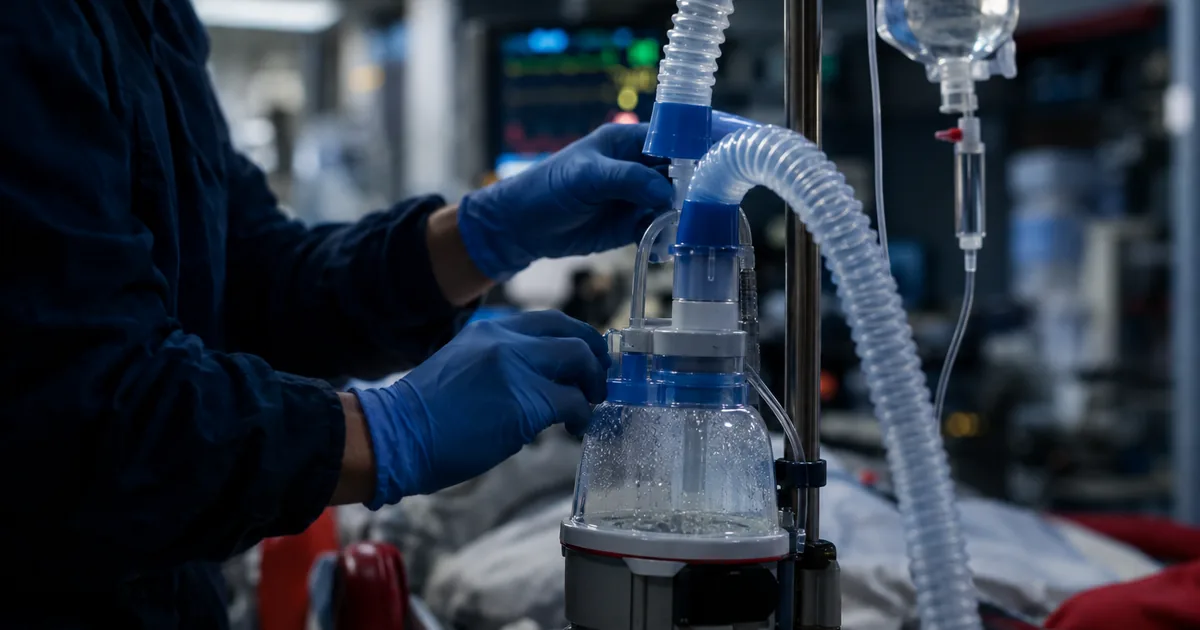
The 2025 ATS guideline now suggests corticosteroids for severe community-acquired pneumonia. Here are the criteria, the trials behind them, and why the 24-hour window starts in the ED.
The 71-year-old retired farmer has had three days of cough and came in by ambulance this morning. Now he is breathing 32 times a minute with an SpO2 of 89% on high-flow nasal cannula at 50 L/min and FiO2 0.6. His chest film shows right lower and middle lobe consolidation, and his CRP just resulted at 260 mg/L. The respiratory viral panel is still running, the ICU bed is three hours out, and the intensivist on the phone asks whether you have started steroids.
Bottom line: for an adult with severe community-acquired pneumonia and no influenza, start hydrocortisone 200 mg per day in the ED within 24 hours of meeting severity criteria, especially with a PaO2/FiO2 below 300 or a CRP above 204 mg/L. Do not give corticosteroids for nonsevere pneumonia.
What the 2025 ATS guideline changed
The 2025 American Thoracic Society guideline reversed the 2019 position for severe disease [1]. For adult inpatients with severe CAP, it suggests systemic corticosteroids (conditional recommendation, low quality of evidence), excluding severe CAP caused by influenza. Fifteen of 16 panel members voted in favor [1]. For nonsevere CAP, it recommends against corticosteroids (strong recommendation), because hyperglycemia is a well-documented harm [1].
The guideline defines severe CAP as one major criterion or at least three minor criteria [1]:
- Major: septic shock requiring vasopressors, or respiratory failure requiring mechanical ventilation
- Minor: respiratory rate of 30 or more, PaO2/FiO2 of 250 or less, multilobar infiltrates, confusion, BUN of 20 mg/dL or more, WBC below 4,000/μL, platelets below 100,000/μL, core temperature below 36°C, or hypotension requiring aggressive fluids
Factors that strengthen the case for steroids are early presentation, the ability to start within 24 hours of meeting severe criteria, ICU admission, PaO2/FiO2 below 300, and elevated CRP or IL-6 [1]. Factors that weaken it are more than 72 hours since severe CAP began, no respiratory failure, normal inflammatory markers, influenza, Aspergillus, uncontrolled diabetes, recent GI bleeding, and pregnancy [1]. The recommendation does not apply to immunocompromised patients [1].
In the guideline's pooled analysis of severe CAP trials, mortality was 9.8% with corticosteroids versus 15.1% without (RR 0.62, 95% CI 0.41 to 0.94), a number needed to treat of 17 [1]. The guideline names no agent or duration. It points to the CAPE COD regimen as the one with the most compelling results [1].
CAPE COD: who was in it
CAPE COD was a phase 3, double-blind, placebo-controlled trial in 31 French ICUs, enrolling from 2015 to 2020 [2]. Adults qualified with clinical and radiologic pneumonia plus at least one of four severity markers [2]:
- New invasive or noninvasive ventilation with PEEP of at least 5 cm H2O
- High-flow nasal cannula with FiO2 of 50% or more and PaO2/FiO2 below 300
- An estimated PaO2/FiO2 below 300 on a nonrebreather
- A Pneumonia Severity Index above 130
Septic shock, influenza, and a do-not-intubate order were exclusions [2]. Hydrocortisone ran as a continuous infusion at 200 mg per day, started within 24 hours of the first severity criterion. On day 4, patients who had improved by predefined criteria got 4 days at full dose, and the rest got 7 days. Both groups then tapered, for a total of 8 or 14 days, and treatment stopped at ICU discharge [2].
The trial stopped at the second interim analysis with 800 randomized, short of the planned 1,200, and analyzed 795 [2]. Death by day 28 was 6.2% (25 of 400) with hydrocortisone versus 11.9% (47 of 395) with placebo, an absolute difference of −5.6 percentage points (95% CI −9.6 to −1.7) [2]. At 90 days, mortality was 9.3% versus 14.7% [2]. Among patients not intubated at baseline, 19.5% of the hydrocortisone group were intubated by day 28 versus 27.7% with placebo (HR 0.69). Among patients not on vasopressors, 15.3% versus 25.0% started them (HR 0.59) [2].
Hospital-acquired infection (9.8% vs 11.1%) and GI bleeding (2.2% vs 3.3%) did not differ [2]. Insulin requirements rose: among patients receiving insulin, the median dose by day 7 was 35.5 versus 20.5 units per day [2]. Only 6.0% of the hydrocortisone group was immunosuppressed, and the authors advised caution in that population [2].
Why two other trials disagree
ESCAPe randomized 586 patients in 42 Veterans Affairs medical centers from 2012 to 2016, short of its 1,420 target [3]. Patients needed one major or three minor modified ATS/IDSA criteria and admission to intensive or intermediate care. Enrollment was allowed within 72 to 96 hours of hospital presentation, and the median time to treatment was 40 hours [3]. Methylprednisolone 40 mg per day for 7 days, tapered over 20 days, did not reduce 60-day mortality (16% vs 18%; adjusted OR 0.90, 95% CI 0.57 to 1.40) [3]. In the prespecified subgroups (ventilation status, APACHE III quartile, CAP vs health care–associated pneumonia), the authors found no significant between-group differences. Complications did not differ, and 96% of patients were men [3].
REMAP-CAP tested hydrocortisone 50 mg every 6 hours for 7 days against no corticosteroid in 658 adults in 18 countries [4]. Patients had to be admitted to the ICU within 48 hours of presentation and randomized within 24 hours of ICU admission. They needed ventilation, high-flow oxygen at 30 L/min or more with FiO2 of 0.4 or more, or any vasopressor or inotrope [4]. The hydrocortisone arm stopped for futility. Day-90 mortality was 15% (78 of 521) with hydrocortisone versus 9.8% (12 of 122) with control [4]. Within each stratum, the median adjusted OR favored control, and every credible interval crossed 1 [4]:
- Shock, no influenza: 16.3% vs 13.0%, OR 1.53
- No shock, no influenza: 13.8% vs 6.8%, OR 1.63
- Influenza strata: 54 patients combined, OR 1.52 to 1.62
The authors concluded that a large mortality reduction is unlikely and that smaller benefit or possible harm cannot be excluded [4]. Two features matter for interpretation. A data-labeling error pushed adaptive randomization toward hydrocortisone, leaving only 122 controls [4]. And unlike CAPE COD, REMAP-CAP enrolled patients in shock, and 39.7% of its hydrocortisone group were intubated at baseline [4]. The 2025 ATS evidence review was completed before REMAP-CAP reported [1].
CRP as the selection signal
Smit and colleagues pooled individual patient data from eight placebo-controlled trials of 3,224 hospitalized CAP patients [5]. Overall, 30-day mortality was 6.6% with corticosteroids versus 8.7% with placebo (OR 0.72, 95% CI 0.56 to 0.94) [5]. A model trained on six trials selected CRP as the effect modifier, and the authors validated it in CAPE COD and ESCAPe [5]. In those two trials, patients with CRP of 204 mg/L or less showed no effect (n = 725; OR 0.98, 95% CI 0.63 to 1.50). Patients with CRP above 204 mg/L had 30-day mortality of 6.1% with corticosteroids versus 13.0% with placebo (n = 630; OR 0.43, 95% CI 0.25 to 0.76) [5]. The threshold is derived, not prospectively tested.
Key Takeaways
- Severe CAP means one major or three minor ATS criteria. A respiratory rate of 30 or more, PaO2/FiO2 of 250 or less, and multilobar infiltrates already make three.
- Start hydrocortisone 200 mg per day within 24 hours of meeting severe criteria in adults without influenza or immunocompromise, and skip it for nonsevere CAP.
- The strongest signal is in hypoxemic patients without shock who are treated early (CAPE COD: 28-day mortality 6.2% vs 11.9%).
- Send CRP with the first labs. Above 204 mg/L, pooled trial data showed 30-day mortality of 6.1% vs 13.0%.
FAQ
Should patients with severe pneumonia get steroids in the emergency department?
The 2025 ATS guideline suggests systemic corticosteroids for adults with severe CAP, excluding influenza and immunocompromised patients [1]. It lists starting within 24 hours of meeting severe criteria as a factor that strengthens the recommendation, so the decision usually belongs to the ED team before ICU arrival [1].
What hydrocortisone dose was used in CAPE COD?
CAPE COD used a continuous IV infusion of 200 mg per day for 4 or 7 days, depending on improvement at day 4, then a taper to a total of 8 or 14 days [2]. Treatment stopped at ICU discharge [2].
Why did REMAP-CAP not show benefit from hydrocortisone?
REMAP-CAP found 90-day mortality of 15% with hydrocortisone versus 9.8% with control, with all credible intervals crossing 1 [4]. It enrolled patients in shock and more intubated patients than CAPE COD did. A labeling error also left it with only 122 controls [4].
Dr. Chet's Take
I have worked this problem from two seats, as an ED attending holding hypoxic pneumonia patients for ICU beds and as a critical care transport medical director whose crews move them between hospitals. This article gets the core point right. The decision to treat with steroids is made in the first hours, and the first hours belong to us. Boarding makes it worse. A patient who waits eight hours in the department for a bed has used a third of the window before the ICU team ever examines him. The argument holds for the CAPE COD patient: hypoxemic, inflamed, not in shock, and caught early. That patient arrives through our doors every winter, and too often the steroid conversation waits for the intensivist's admission note.
That being said, I would not let REMAP-CAP be explained away because of its randomization error. The honest answer is that we have one strongly positive trial, one negative trial with a slower enrollment window, and one large trial pointing toward harm in a sicker population. That pattern says patient selection carries the effect, and selection is our job. The influenza exclusion also has teeth. In a winter with a pending viral panel, I would rather wait an hour for the swab than start a drug the guideline excludes for flu. I also expect the CRP threshold to get misused in both directions. A CRP of 190 in a patient on high-flow with multilobar disease still meets the guideline. A CRP of 300 on two liters of oxygen still describes nonsevere pneumonia.
If you are working the ED, put severe pneumonia on your order set with the three steps together: severity criteria, CRP, and a rapid flu test. Document the time severe criteria were met so the ICU knows where the 24-hour window stands, and say it out loud at handoff. Ask pharmacy now whether a continuous hydrocortisone infusion can start in your department, and add point-of-care glucose checks to the same order set. If you are the department chair, build that order set with your intensivists this month rather than after the next surge, and review a sample of severe pneumonia charts each quarter to see whether the severity time was recorded. The 24-hour window opens in the emergency department, and the emergency physician owns the first hours of it.
— Chester Shermer, MD, FACEP | Emergency Medicine, 25+ Years Clinical Experience | State Surgeon
Continue Your Training
If you're an emergency physician (or any clinician treating patients daily) trying to understand how AI will actually impact your clinical practice — not just the hype — I put together a free practical guide. You can download the AI in EM Survival Guide here.
Browse All Courses at Global MedOps Command
Relevant Reading on Global MedOps Command:
How to Avoid Becoming an AI Casualty — Dr. Shermer's guide to navigating AI tools in clinical and operational settings without compromising judgment or patient outcomes.
Emergency Department Efficiency Playbook — Practical systems for throughput, triage optimization, and operational efficiency.
Read more from Dr. Shermer on Medium
Connect with Dr. Shermer: LinkedIn — Chester "Chet" Shermer, MD, FACEP.
References
- Jones BE, Ramirez JA, Oren E, et al. Diagnosis and management of community-acquired pneumonia: an official American Thoracic Society clinical practice guideline. Am J Respir Crit Care Med. 2025;212(1):24-44. PubMed 40679934
- Dequin PF, Meziani F, Quenot JP, et al. Hydrocortisone in severe community-acquired pneumonia. N Engl J Med. 2023;388(21):1931-1941. PubMed 36942789
- Meduri GU, Shih MC, Bridges L, et al. Low-dose methylprednisolone treatment in critically ill patients with severe community-acquired pneumonia. Intensive Care Med. 2022;48(8):1009-1023. PubMed 35723686
- REMAP-CAP Investigators, Angus DC, et al. Effect of hydrocortisone on mortality in patients with severe community-acquired pneumonia: the REMAP-CAP Corticosteroid Domain randomized clinical trial. Intensive Care Med. 2025;51(4):665-680. PubMed 40261382
- Smit JM, Van Der Zee PA, Stoof SCM, et al. Predicting benefit from adjuvant therapy with corticosteroids in community-acquired pneumonia: a data-driven analysis of randomised trials. Lancet Respir Med. 2025;13(3):221-233. PubMed 39892408
Related simulation training: EM-Sim · Books by Dr. Shermer