Ketamine or Etomidate for ED Intubation: What the RSI Trial Found
Chester "Chet" Shermer, MD, FACEP · November 12, 2026
About the author: Dr. Chester Shermer, MD, FACEP
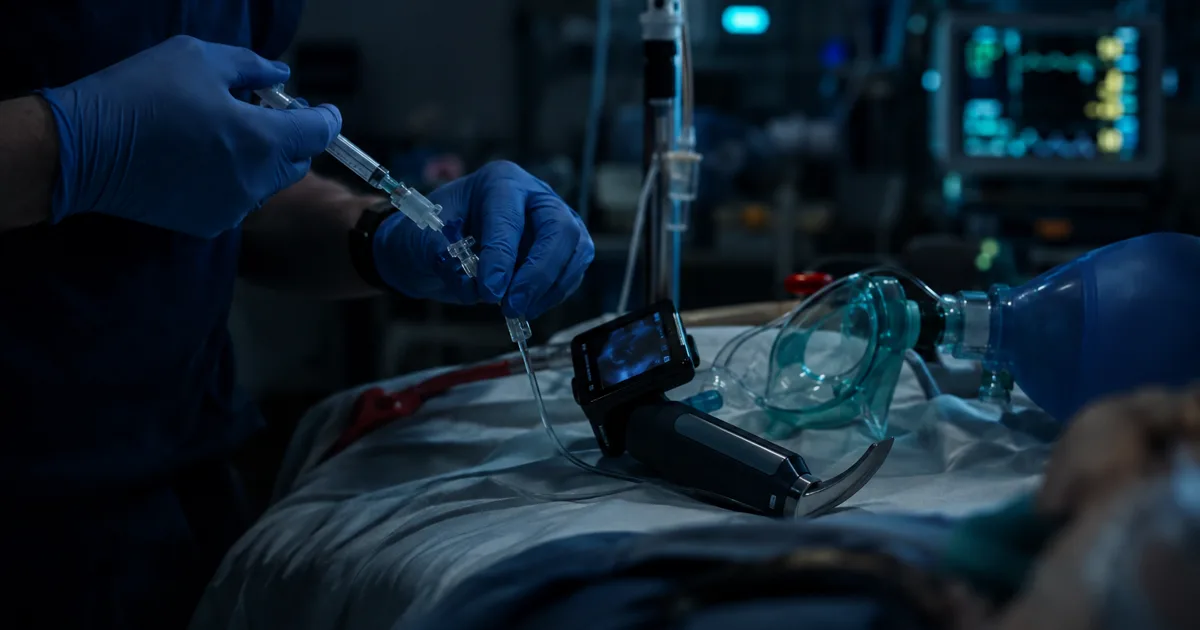
In 2,365 critically ill adults, ketamine did not lower 28-day mortality and caused more peri-intubation collapse, most in sepsis. How to pick the agent.
A 68-year-old retired farmer arrives from a nursing facility with urosepsis, a systolic pressure in the low 90s on peripheral norepinephrine, and a falling level of consciousness. His saturation is drifting down on a nonrebreather, and the team decides to intubate. The resident draws up ketamine because "it holds the pressure." The pharmacist asks whether anyone wants etomidate instead, and the room looks at the attending.
Bottom line: in critically ill adults without trauma, etomidate is a sound default for induction. Ketamine did not lower 28-day mortality in the largest trial ever run on this question, and it produced more peri-intubation cardiovascular collapse, most of all in patients with sepsis or an APACHE II score of 20 or higher.
The RSI Trial: Design and Who Was Enrolled
The Randomized trial of Sedative choice for Intubation (RSI) was a pragmatic, unblinded, multicenter trial run at 14 sites in 6 US medical centers: 6 emergency departments and 8 intensive care units [1]. It enrolled critically ill adults 18 years and older undergoing tracheal intubation with an induction drug, using exception from informed consent, between April 2022 and August 2025.
Patients were excluded if they were known to be pregnant or incarcerated, presented with a primary diagnosis of trauma, needed intubation too urgently to randomize, or if the treating clinicians judged one of the two drugs necessary or contraindicated [1]. Of 3,439 patients screened, 2,365 were analyzed: 1,176 assigned to ketamine and 1,189 to etomidate.
The population looked like a busy resuscitation bay. Median age was 60, 46.7% had sepsis or septic shock, 22.0% were on vasopressors, and 55.7% were intubated in the ED [1]. Median APACHE II score was 18.
Dosing was clinician-selected from a weight-based nomogram: ketamine 1.0, 1.5, or 2.0 mg/kg, and etomidate 0.2, 0.25, or 0.3 mg/kg [1]. The median ketamine dose was 1.6 mg/kg of actual body weight and the median etomidate dose 0.28 mg/kg. Adherence was 99.2% in the ketamine group and 99.6% in the etomidate group, video laryngoscopy was used on the first attempt in about 95% of patients, and rocuronium was the paralytic in 69%.
Mortality: No Difference at 28 Days, Including Sepsis
The primary outcome was in-hospital death by day 28. It occurred in 28.1% of the ketamine group and 29.1% of the etomidate group, a site-adjusted risk difference of -0.8 percentage points (95% CI -4.5 to 2.9; P = 0.65) [1]. Death in any location by day 28 was 32.2% versus 32.4%.
The sepsis subgroup carried the hypothesis, since adrenal suppression from etomidate is the classic argument against it in septic shock. Among the 1,101 patients with sepsis, in-hospital death by day 28 was 38.8% with ketamine and 38.2% with etomidate, a risk difference of 1.0 percentage point (95% CI -4.8 to 6.7) [1]. The authors reported no difference in death at any time point or within any prespecified subgroup, and risk-modeling and machine-learning effect-modeling analyses found no heterogeneity of treatment effect.
At 24 hours, 38.9% of the ketamine group and 42.3% of the etomidate group were still on vasopressors, a difference of -3.4 points (95% CI -7.5 to 0.7) [1]. Ventilator-free, vasopressor-free, and ICU-free days were similar.
Cardiovascular Collapse Was More Common With Ketamine
The single prespecified secondary outcome was cardiovascular collapse between induction and 2 minutes after intubation, defined as systolic pressure below 65 mm Hg, a new or increased vasopressor, or cardiac arrest. It occurred in 22.1% of the ketamine group and 17.0% of the etomidate group, a difference of 5.1 percentage points (95% CI 1.9 to 8.3) [1].
Most of that gap came from vasopressors: new or increased vasopressor receipt was 21.3% versus 15.9%. Systolic pressure below 65 mm Hg (6.4% vs 5.5%) and cardiac arrest (1.0% vs 0.8%) did not differ meaningfully [1]. A systolic pressure below 80 mm Hg occurred in 14.4% versus 10.6%, and a systolic drop of more than 30 mm Hg in 23.9% versus 14.7%.
The difference widened in the sickest patients. In sepsis, collapse occurred in 30.6% with ketamine and 20.9% with etomidate (difference 9.7 points; 95% CI 4.6 to 14.9) [1]. With an APACHE II score of 20 or higher, it was 31.4% versus 20.7% (difference 10.7 points; 95% CI 5.5 to 16.0).
Ventricular tachycardia, a post hoc outcome added after the first 567 patients, occurred in 1.0% with ketamine and 0.2% with etomidate [1]. Severe hypoxemia below 80% was 11.1% in both groups, first-attempt success was 85.7% versus 86.7%, and median time from induction to intubation was 9 seconds longer with ketamine.
How It Fits With Earlier Trials
Before RSI, the randomized evidence came mainly from two trials. KETASED, run across French prehospital services, EDs, and ICUs, randomized 655 patients to etomidate 0.3 mg/kg or ketamine 2 mg/kg and analyzed 469 [2]. Maximum SOFA score over the first 3 days did not differ (10.3 vs 9.6; P = 0.056), and adrenal insufficiency was more common with etomidate (OR 6.7).
The EvK trial, a single-center US trial of 801 patients, found higher day 7 survival with ketamine (85.1% vs 77.3%), but day 28 survival did not differ (66.8% vs 64.1%) [3]. RSI enrolled roughly as many patients as all prior trials combined and showed no mortality difference at any time point [1].
A 2026 meta-analysis of 8 randomized trials and 4,807 patients found no mortality difference (RR 0.97; 95% CI 0.89 to 1.06) and a higher risk of cardiovascular collapse with ketamine (RR 1.34; 95% CI 1.16 to 1.54), with the caution that the collapse estimate rested on two open-label trials with differing definitions [4]. An observational secondary analysis of 2,357 patients from the DEVICE and PREOXI trials found the same direction, with collapse in 20.4% of ketamine recipients and 14.0% of etomidate recipients (aOR 1.80; 95% CI 1.24 to 2.62); the authors cautioned that induction drug was not randomized there [5].
Choosing the Agent and the Dose at the Bedside
The adrenal argument against etomidate in sepsis has now been tested directly in more than 1,100 septic patients, and mortality did not move. The hemodynamic argument for ketamine was tested too, and it ran the other way.
Ketamine still has a place. RSI excluded patients with a primary trauma diagnosis, so it says nothing about the multisystem trauma patient [1]. It also excluded patients in whom clinicians judged one drug necessary or contraindicated, so those bedside judgments stand outside its results. Supply matters too: where etomidate is unavailable, ketamine is the agent with the most randomized data behind it.
When ketamine is the choice in a septic patient, the trial predicts collapse in roughly 3 of every 10. The trial's dose band, 1.0 to 2.0 mg/kg, is the range with outcome data behind it; whether doses at the low end blunt that risk was not reported in the main paper [1].
Two limits matter. The trial was unblinded, so observers knew the drug when they recorded procedural outcomes, and the confidence interval for mortality does not exclude a small difference in either direction [1]. Neither point changes the bedside choice for the septic patient in the low 90s.
Key Takeaways
- In 2,365 critically ill adults, 28-day in-hospital death was 28.1% with ketamine and 29.1% with etomidate; in sepsis it was 38.8% versus 38.2%.
- Cardiovascular collapse within 2 minutes of intubation was 22.1% with ketamine versus 17.0% with etomidate, rising to 30.6% versus 20.9% in sepsis and 31.4% versus 20.7% with APACHE II of 20 or higher.
- For nontraumatic critically ill adults, use etomidate 0.2 to 0.3 mg/kg as the default; if ketamine is used in sepsis, plan for collapse in about 3 of 10 patients.
- RSI excluded primary trauma, so the trauma bay still runs on judgment and older data.
FAQ
Is ketamine or etomidate better for intubation in septic shock?
In the RSI trial's 1,101 patients with sepsis, 28-day in-hospital death was 38.8% with ketamine and 38.2% with etomidate [1]. Cardiovascular collapse during intubation was higher with ketamine, 30.6% versus 20.9%. On current evidence, etomidate carries no survival penalty in sepsis and causes less peri-intubation hypotension.
Does a single dose of etomidate cause adrenal insufficiency?
Yes, biochemically. Etomidate inhibits 11-beta-hydroxylase, and a single dose suppresses cortisol production for up to 72 hours [1]. In KETASED, adrenal insufficiency was more common after etomidate (OR 6.7), but KETASED found no significant difference in early organ failure scores, and RSI found no difference in mortality [1,2].
What dose of ketamine and etomidate did the RSI trial use?
Clinicians chose from a weight-based nomogram: ketamine 1.0, 1.5, or 2.0 mg/kg, or etomidate 0.2, 0.25, or 0.3 mg/kg [1]. The median doses actually given were ketamine 1.6 mg/kg and etomidate 0.28 mg/kg of actual body weight.
Dr. Chet's Take
I have spent more than 25 years as an emergency physician at a Level I academic trauma center, and as a HEMS and critical care transport medical director I answer for the induction drugs our crews carry into some of the hardest airways anyone manages. When an induction drug goes wrong in the aircraft, the review lands on my desk. This trial earns attention because it answers the question the field kept arguing about with small studies and strong opinions. The core argument holds. The adrenal fear around etomidate was real biochemistry that never turned into a body count, and the reputation ketamine built as the blood-pressure-friendly drug did not survive randomization. Good trials do this. They take a belief everyone repeats on rounds and make it pay rent.
That being said, the mortality result is the headline, but the collapse result is the one that changes what happens in the next ten minutes. A pressor bump in the first two minutes sounds minor on paper. In a patient with no reserve, it is the start of the post-intubation arrest you spend the next hour explaining. The honest answer is that these numbers came from a trained observer watching every case, and most departments have nobody watching the two minutes after the tube goes in. Your own collapse rate is probably invisible to you. Nor does this trial settle the trauma patient, which is the population many of us reach for ketamine on reflex. Shock index, preload, and the plan for the first breath on the ventilator matter as much as which vial gets pushed.
If you are the attending in the bay, say the induction agent out loud during the pause before you push, and make the team name the backup pressor, its dose, and who will give it. If you are on a pharmacy or airway committee, look at what your RSI kits stock and whether the default drug matches this evidence, then pull the lowest blood pressure in the ten minutes after every intubation for one quarter. That single number will tell you more about your department than any journal club. For the patient already on a pressor, have the infusion running and titratable before induction, with the pump already programmed and someone assigned to it. Do not let a decade-old teaching point pick the drug for you. The induction agent is a decision, and decisions belong to the attending.
— Chester Shermer, MD, FACEP | Emergency Medicine, 25+ Years Clinical Experience | State Surgeon
Continue Your Training
If you're an emergency physician (or any clinician treating patients daily) trying to understand how AI will actually impact your clinical practice — not just the hype — I put together a free practical guide. You can download the AI in EM Survival Guide here.
Browse All Courses at Global MedOps Command
Relevant Reading on Global MedOps Command:
How to Avoid Becoming an AI Casualty — Dr. Shermer's guide to navigating AI tools in clinical and operational settings without compromising judgment or patient outcomes.
Emergency Department Efficiency Playbook — Practical systems for throughput, triage optimization, and operational efficiency.
Read more from Dr. Shermer on Medium
Connect with Dr. Shermer: LinkedIn — Chester "Chet" Shermer, MD, FACEP.
References
- Casey JD, Seitz KP, Driver BE, et al. Ketamine or etomidate for tracheal intubation of critically ill adults. N Engl J Med. 2026;394(16):1608-1620. PubMed 41369227
- Jabre P, Combes X, Lapostolle F, et al. Etomidate versus ketamine for rapid sequence intubation in acutely ill patients: a multicentre randomised controlled trial. Lancet. 2009;374(9686):293-300. PubMed 19573904
- Matchett G, Gasanova I, Riccio CA, et al. Etomidate versus ketamine for emergency endotracheal intubation: a randomized clinical trial. Intensive Care Med. 2022;48(1):78-91. PubMed 34904190
- Elbahloul MA, Gamal A, Samir AA, et al. Ketamine versus etomidate as an induction agent for tracheal intubation: an updated meta-analysis of randomized clinical trials. Anaesth Crit Care Pain Med. 2026:101910. PubMed 42772417
- Khan A, Singer-Englar T, Aggarwal N, et al. Ketamine vs. etomidate and cardiovascular collapse during emergency tracheal intubation: a secondary analysis of the DEVICE and PREOXI trials. Crit Care Explor. 2026;8(11):e1510. PubMed 43007299
Related simulation training: EMS-MedSim · Books by Dr. Shermer