Calcium Channel Blocker Overdose in the ED: Read the Shock First
Chester "Chet" Shermer, MD, FACEP · November 19, 2026
About the author: Dr. Chester Shermer, MD, FACEP
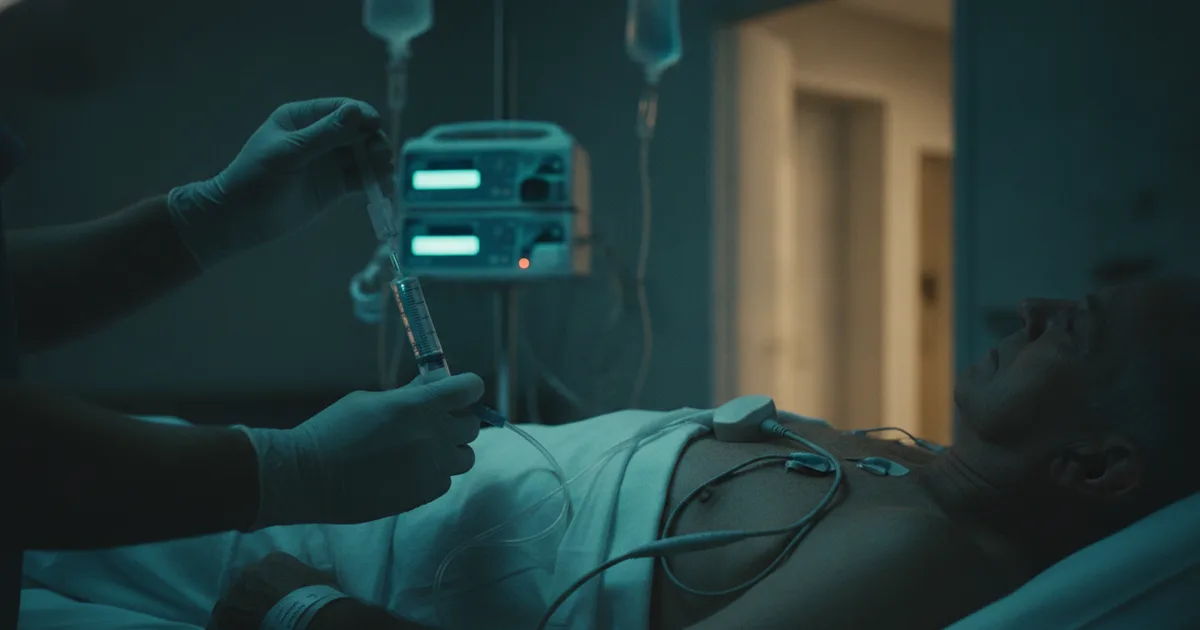
Severe calcium channel blocker poisoning in the first hours: sort vasoplegia from cardiogenic shock at the bedside, dose calcium and high-dose insulin, decontaminate safely, and know when to call for ECMO.
A 61-year-old welder arrives three hours after swallowing his wife's extended-release verapamil, about thirty 240 mg tablets by his own count. He is awake, answering questions and protecting his airway. The monitor shows a junctional rhythm at 42 and a blood pressure of 76/40. His fingerstick glucose is 290 mg/dL, and he is not diabetic. Your bedside echo shows a poorly squeezing left ventricle.
This is a nondihydropyridine overdose with the cardiogenic shock that drug class produces, and with an extended-release product it can keep getting worse for hours. Give IV calcium, start high-dose insulin now because the heart is failing, choose the catecholamine for the shock you see on the echo, and call the poison center and your nearest ECMO center in the first hour.
Two drug classes, two kinds of shock
Verapamil and diltiazem poisoning typically produces bradycardia and a weak ventricle, which is cardiogenic shock [3]. Amlodipine and the other dihydropyridines typically produce vasoplegia with a preserved or hyperdynamic ventricle [3]. An amlodipine overdose can present with hypotension and a reflex tachycardia before bradycardia develops [1]. In a large overdose, that selectivity is lost, and either class can produce both pictures [2].
So the label on the bottle starts the diagnosis, and the echo finishes it. A hyperdynamic ventricle with a low blood pressure means vasoplegia. A weak, slow ventricle means cardiogenic shock. A 2026 proposal builds the whole treatment pathway on that bedside split; it has not yet been tested in patients [3].
The glucose earns a place in the first set of numbers. These drugs block the pancreatic calcium channels that release insulin and cause insulin resistance in the tissues [4]. In a five-hospital retrospective series of 40 verapamil and diltiazem overdoses, the median initial glucose was 188 mg/dL in patients who died, needed pacing or needed vasopressors, against 129 mg/dL in those who did not [4]. The median peak glucose was 364 against 145 mg/dL [4]. The authors found that the percentage rise in glucose predicted severity better than the changes in heart rate or blood pressure, and asked for prospective validation [4]. The welder's 290 belongs in that picture.
Send acetaminophen, salicylate and digoxin levels to look for a co-ingestion [1].
First line: calcium, insulin and the right catecholamine
The 2017 expert consensus recommendations remain the source for in-hospital treatment and doses, and every one of their recommendations rests on very low-quality evidence [2]. The panel did not rank the first-line therapies. It asked clinicians to choose by the effect they need, alone or together [2].
IV calcium is recommended first line [2]. The panel's regimen is 10% calcium chloride, 10 to 20 mL (1 to 2 g) every 10 to 20 minutes, or an infusion at 0.2 to 0.4 mL/kg per hour [2]. With 10% calcium gluconate, the choice to spare a peripheral vein, the dose is 30 to 60 mL (3 to 6 g) every 10 to 20 minutes, or 0.6 to 1.2 mL/kg per hour [2]. The panel judged IV calcium low risk when it runs through a central line or a secure peripheral line [2].
High-dose insulin is recommended when the heart is failing, and suggested even before myocardial function has been measured, when given with fluids, calcium and vasopressors [2]. The regimen is regular insulin 1 unit/kg as a bolus, then 1 unit/kg per hour, with a dextrose infusion to hold the glucose normal and close potassium checks [2]. Increase toward 10 units/kg per hour only in patients who have not responded to first-line therapy, because only case series support those doses [2]. In pure vasoplegia, the 2026 echo-guided proposal warns that high-dose insulin could make things worse [3]; the 2017 panel still suggests it there when it is given with fluids, calcium and vasopressors [2].
Catecholamines follow the echo. Norepinephrine is the choice for vasodilatory shock, or for any shock before you have seen the heart [2]. Epinephrine or dobutamine fits the weak ventricle [2]. The panel suggests against dopamine, and against vasopressin as the only vasoactive drug when cardiogenic shock is documented [2]. Expect to need high infusion rates [2].
Atropine, 0.5 mg every 3 to 5 minutes for a few doses, is suggested for symptomatic bradycardia or conduction block and may help for a short time [2]. The panel made no formal fluid recommendation, but treated crystalloid as first line: 10 to 20 mL/kg over 10 to 15 minutes, continued while the patient still responds [2]. The same shock-first habits from the undifferentiated hypotension approach apply.
Decontamination and the patient who looks well
A patient who looks well three hours after an extended-release ingestion has not yet shown you his worst. After a potentially toxic ingestion, meaning more than one therapeutic dose, the consensus panel advises about 24 hours of monitored observation, based on case series [2].
The 2026 recommendations from the Clinical Toxicology Recommendations Collaborative list calcium channel blockers among the poisons for which activated charcoal is appropriate, and add a second dose after verapamil to finish decontamination [5]. The group no longer holds charcoal to the traditional first hour; the time limit differs by poison and by formulation [5]. The same group advises against intubating solely to give charcoal, unless the patient is expected to develop clinically significant toxicity [5]. The welder is still awake and protecting his airway, so he gets charcoal now, with suction at the bedside and an airway plan ready if his mental status or pressure falls. If he needs intubation later, charcoal by orogastric tube is reasonable [5].
Whole bowel irrigation can be considered for sustained-release drugs, particularly beyond two hours after ingestion [6]. It is contraindicated in hemodynamic instability or an unprotected airway [6], which rules it out for the welder at a pressure of 76/40.
Dialysis does not help. The EXTRIP workgroup judged these drugs not dialyzable and recommends against extracorporeal removal in severe amlodipine, diltiazem or verapamil poisoning [7].
When first line fails
Refractory shock moves to the next tier [2]:
- More insulin, titrated toward 10 units/kg per hour when the ventricle is weak [2].
- Pacing for unstable bradycardia or high-grade AV block when contraction is still reasonable. Try transcutaneous pacing first; capture is often difficult in these patients [2].
- Lipid emulsion. The panel set no dose; the regimen most often used is 20% emulsion at 1.5 mL/kg as a bolus, repeated up to twice, then 0.25 mL/kg per minute for 30 to 60 minutes, with an FDA maximum of 12.5 mL/kg in 24 hours [2]. The panel kept it out of early care because the response is inconsistent and lipid may increase absorption of drug still in the gut [2].
- VA-ECMO when refractory shock has a significant cardiogenic component, in centers that offer it [2].
The ECMO evidence is observational. In a retrospective cohort from two French university hospitals, 12 of 14 poisoned patients (86%) treated with extracorporeal life support survived, against 23 of 48 (48%) treated without it; the cohort included many different drugs, and one of the two centers offered ECLS preferentially [8]. That falls short of proof of benefit, but it argues for knowing your nearest ECMO center and its referral number before this patient arrives.
For cardiac arrest, the panel recommends IV calcium, even if already given, and lipid emulsion on top of standard ACLS, and suggests VA-ECMO where available [2]. The 2025 American Heart Association guidelines on special circumstances of resuscitation, the current edition, give graded recommendations for calcium channel blocker poisoning and for ECMO in poisoned patients [9].
The 2017 panel did not recommend glucagon or methylene blue [2]. The 2026 proposal offers methylene blue as a trial for refractory vasoplegia [3]. No controlled study supports it.
Key Takeaways
- Echo early: a hyperdynamic heart means vasoplegia and norepinephrine; a weak, slow heart means epinephrine or dobutamine and high-dose insulin [2][3].
- Insulin dose: regular insulin 1 unit/kg, then 1 unit/kg per hour with dextrose and potassium checks; reserve rates toward 10 units/kg per hour for nonresponders [2].
- Calcium dose: 10% calcium chloride 10 to 20 mL, or 10% gluconate 30 to 60 mL, every 10 to 20 minutes or by infusion [2].
- Observe a well-looking extended-release ingestion for about 24 hours, give charcoal if the airway is safe, and do not send the patient for dialysis [2][5][7].
FAQ
What is the high-dose insulin dose for calcium channel blocker overdose?
The 2017 consensus regimen is regular insulin 1 unit/kg IV as a bolus, then 1 unit/kg per hour [2]. Run dextrose to keep the glucose normal and check potassium closely [2]. Titrate toward 10 units/kg per hour only when first-line therapy has failed [2].
Calcium chloride or calcium gluconate for calcium channel blocker toxicity?
The consensus panel gives a regimen for each. Calcium chloride 10%, 10 to 20 mL, delivers 1 to 2 g [2]. Calcium gluconate 10%, 30 to 60 mL (3 to 6 g), is the choice to spare a peripheral vein [2]. The panel judged IV calcium low risk through a central line or a secure peripheral line [2]. Both can be repeated every 10 to 20 minutes or run as an infusion [2].
How long do you observe an extended-release calcium channel blocker ingestion?
The consensus panel advises about 24 hours of monitored observation after more than a single therapeutic dose, even when the patient looks well [2]. Charcoal is appropriate if the airway is protected [5].
Dr. Chet's Take
I have practiced emergency medicine for more than 25 years and now work at a Level I academic trauma center, and as a HEMS and critical care transport medical director I think about where this patient will be in four hours, not just where he is now. The article gets the core right, and its central argument holds. Many of us learned this overdose as a list of antidotes to try one after another. The better habit is to give the treatments that fit the physiology at the same time, because the patient does not wait for one to fail before he gets worse. Weak evidence is no excuse to wait for better data while the pressure falls. One thing the article leaves out: many of these ingestions are deliberate. The safety plan, the sitter and the conversation with the family belong in the same hour as the calcium, because the patient who survives the shock still has the reason he swallowed the bottle.
That being said, the article treats ECMO as a decision, and in most of the country it is a transport. The cannula is in another building, often in another city. Someone has to move a patient on two vasopressors, an insulin drip, concentrated dextrose, potassium and calcium, and every pump has to come with him. A critical care transport team can do that, but only if the drips are labeled, the concentrations are written down and the receiving team has heard the plan before the wheels turn. A patient who is periarrest cannot travel at all. The honest answer is that nobody has studied the right moment to call. I would rather have an ECMO team decline a patient who improved than accept one I can no longer move.
If you are the attending in a smaller hospital, check your stock before you need it. Know how many grams of calcium chloride, how much concentrated dextrose and how many vials of regular insulin your pharmacy can hand you tonight. A 100 kg patient at 1 unit/kg per hour, plus the bolus, uses a 1,000-unit vial in under ten hours, and more as you titrate up. Ask the poison center to help write the drip orders, and assign one nurse to the glucose and potassium checks so they do not drift behind the pressors. When you call the receiving center, give them the drug, the time of ingestion, the formulation and every drip with its rate, so the transport team can set up before it arrives. If you are the resident, learn the calcium and insulin doses cold; you will not have time to look them up. Then call the receiving center while your patient can still make the trip.
— Chester Shermer, MD, FACEP | Emergency Medicine, 25+ Years Clinical Experience | State Surgeon
Continue Your Training
If you're an emergency physician (or any clinician treating patients daily) trying to understand how AI will actually impact your clinical practice — not just the hype — I put together a free practical guide. You can download the AI in EM Survival Guide here.
Browse All Courses at Global MedOps Command
Relevant Reading on Global MedOps Command:
How to Avoid Becoming an AI Casualty — Dr. Shermer's guide to navigating AI tools in clinical and operational settings without compromising judgment or patient outcomes.
Emergency Department Efficiency Playbook — Practical systems for throughput, triage optimization, and operational efficiency.
Read more from Dr. Shermer on Medium
Connect with Dr. Shermer: LinkedIn — Chester "Chet" Shermer, MD, FACEP.
References
- Suarez F, Koyfman A, Long B. Pearls and pitfalls for the emergency clinician: beta blocker and calcium channel blocker toxicity. J Emerg Med. 2026;84:1-11. PubMed 41833262
- St-Onge M, Anseeuw K, Cantrell FL, et al. Experts consensus recommendations for the management of calcium channel blocker poisoning in adults. Crit Care Med. 2017;45(3):e306-e315. PubMed 27749343
- Mehrpour O, Brent J. Proposed echocardiography-guided flowchart for calcium channel blocker overdose: distinguishing vasoplegia from cardiogenic shock. Daru. 2026;34(1). PubMed 41776067
- Levine M, Boyer EW, Pozner CN, et al. Assessment of hyperglycemia after calcium channel blocker overdoses involving diltiazem or verapamil. Crit Care Med. 2007;35(9):2071-2075. PubMed 17855820
- Hoegberg LCG, Gosselin S, Buckley NA, et al. Recommendations from the Clinical Toxicology Recommendations Collaborative on the administration of activated charcoal in acute oral overdose. Clin Toxicol (Phila). 2026;64(6):419-475. PubMed 41906697
- Thanacoody R, Caravati EM, Troutman B, et al. Position paper update: whole bowel irrigation for gastrointestinal decontamination of overdose patients. Clin Toxicol (Phila). 2015;53(1):5-12. PubMed 25511637
- Wong A, Hoffman RS, Walsh SJ, et al. Extracorporeal treatment for calcium channel blocker poisoning: systematic review and recommendations from the EXTRIP workgroup. Clin Toxicol (Phila). 2021;59(5):361-375. PubMed 33555964
- Masson R, Colas V, Parienti JJ, et al. A comparison of survival with and without extracorporeal life support treatment for severe poisoning due to drug intoxication. Resuscitation. 2012;83(11):1413-1417. PubMed 22469751
- Cao D, Arens AM, Chow SL, et al. Part 10: Adult and pediatric special circumstances of resuscitation: 2025 American Heart Association Guidelines for Cardiopulmonary Resuscitation and Emergency Cardiovascular Care. Circulation. 2025;152(16 Suppl 2):S578-S672. PubMed 41122889
Related simulation training: Books by Dr. Shermer