Upper GI Bleeding in the ED: Score, Transfuse Low, Skip the TXA
Chester "Chet" Shermer, MD, FACEP · October 22, 2026
About the author: Dr. Chester Shermer, MD, FACEP
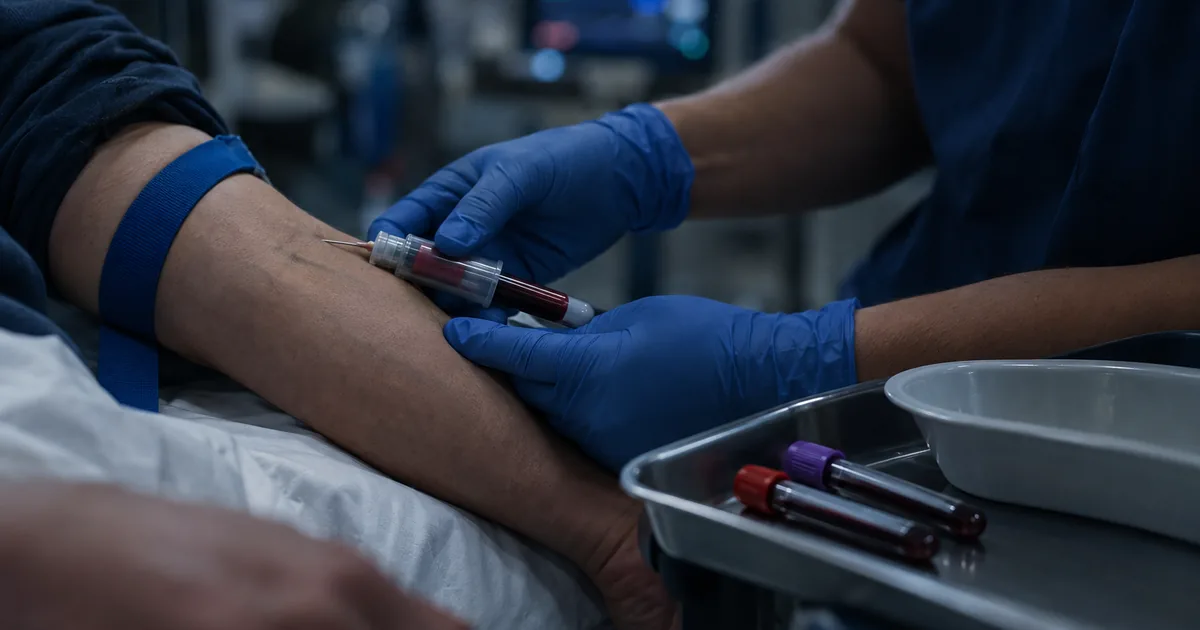
The Glasgow-Blatchford score sends very low-risk patients home, a 7 g/dL threshold beat liberal transfusion, and HALT-IT removed tranexamic acid. What the evidence asks of the ED.
The 46-year-old line cook vomited coffee-ground material twice this morning after a week of ibuprofen for a sore shoulder. He walked in, and his pulse is 88 with a blood pressure of 132/80. He has no melena, no syncope, and no history of liver or heart disease. His hemoglobin is 14.1 g/dL and his BUN is 16 mg/dL. The admitting team wants him upstairs for a scope tomorrow, and a colleague asks whether to start tranexamic acid.
Bottom line: score every upper GI bleed with the Glasgow-Blatchford score. Discharge a score of 0 or 1 with outpatient endoscopy, transfuse hemodynamically stable patients below a hemoglobin of 7 g/dL (8 g/dL with cardiovascular disease), and leave tranexamic acid off the order set.
Who can go home
Blatchford and colleagues built their score from 1,748 patients admitted with upper GI hemorrhage. They designed it to predict the need for transfusion, intervention to control bleeding, rebleeding, or death [1]. It uses admission hemoglobin, blood urea, pulse, systolic blood pressure, presentation with syncope or melena, and evidence of hepatic disease or cardiac failure. No endoscopy is required [1].
Stanley and colleagues tested it prospectively in 3,012 consecutive patients at six hospitals in Europe, North America, Asia, and Oceania from March 2014 to March 2015 [2]. Patients qualified with hematemesis, coffee-ground vomiting, or melena. Patients who started bleeding after admission for another reason were excluded [2]. The composite endpoint was transfusion, endoscopic treatment, interventional radiology, surgery, or death within 30 days [2].
The Glasgow-Blatchford score predicted that endpoint better than any other score, with an AUROC of 0.86. The full Rockall score scored 0.70, and AIMS65 scored 0.68 [2]. Its results at a score of 1 or less were as follows:
- Size of the group: 564 patients, 19% of the cohort.
- Accuracy: sensitivity of 98.6% and specificity of 34.6% for survival without intervention.
- Outcomes in that group: 3.4% needed an intervention or died, endoscopic treatment was needed in 1.4%, and mortality was 0.4%.
Glasgow and Odense already had a policy of not admitting patients with a score of 1 or less, and none of the outpatients died or needed transfusion, surgery, or interventional radiology [2]. One received endoscopic treatment for a minor Mallory-Weiss tear [2]. The low-risk share varied by site, from 9% in Dunedin to 31% in Glasgow [2].
The ACG guideline turns this into a recommendation. Patients classified as very low risk can be discharged from the ED with outpatient follow-up (conditional recommendation, very-low-quality evidence) [3]. Very low risk means a score with a false-negative rate of 1% or less for hospital-based intervention or death, with a Glasgow-Blatchford score of 0 to 1 as the example [3]. AIMS65 and PNED predicted death better than the Glasgow-Blatchford score, but no score reached an AUROC of 0.80 for mortality, rebleeding, or length of stay [2]. The Glasgow-Blatchford score is a discharge tool, and its job is limited to finding patients who will not need the hospital.
Transfuse at 7
Villanueva and colleagues randomized 921 patients with hematemesis, melena, or both at a single Barcelona hospital from 2003 to 2009 [4]. The restrictive strategy transfused below 7 g/dL to a target of 7 to 9 g/dL. The liberal strategy transfused below 9 g/dL to a target of 9 to 11 g/dL [4]. All patients had emergency endoscopy within 6 hours [4]. The exclusions matter for the ED [4]:
- Massive exsanguinating bleeding
- Acute coronary syndrome
- Symptomatic peripheral vasculopathy, stroke, or TIA
- Lower GI bleeding
- Recent trauma or surgery
- A clinical Rockall score of 0 with hemoglobin above 12 g/dL
In the intention-to-treat analysis, 45-day mortality was 5% (23 of 444) with the restrictive strategy versus 9% (41 of 445) with the liberal strategy (HR 0.55; 95% CI, 0.33 to 0.92) [4]. Further bleeding was 10% versus 16% (adjusted HR 0.68; 95% CI, 0.47 to 0.98) [4]. Overall complications were 40% versus 48%, and 51% of the restrictive group never received a transfusion, against 14% of the liberal group [4].
The effect differed by subgroup [4]:
- Child-Pugh A or B cirrhosis: survival favored the restrictive strategy (HR 0.30; 95% CI, 0.11 to 0.85).
- Child-Pugh C cirrhosis: no difference (HR 1.04; 95% CI, 0.45 to 2.37).
- Peptic ulcer bleeding: the HR was 0.70, and the interval crossed 1 (95% CI, 0.26 to 1.25).
The ACG guideline suggests a threshold of 7 g/dL (conditional recommendation, low-quality evidence) [3]. It calls 8 g/dL reasonable with preexisting cardiovascular disease, and allows a threshold above 8 g/dL with acute coronary syndrome based on very limited evidence [3]. It also says transfusing hypotensive patients before the hemoglobin reaches 7 g/dL is reasonable, because those trials excluded exsanguinating bleeding and hemoglobin falls after fluids even without further bleeding [3].
Why tranexamic acid left the order set
HALT-IT randomized 12,009 adults with significant upper or lower GI bleeding at 164 hospitals in 15 countries from 2013 to 2019 [5]. Significant meant at risk of bleeding to death, and the treating clinician had to be substantially uncertain about using tranexamic acid [5]. Patients received 1 g IV over 10 minutes and then 3 g over 24 hours, or a matching placebo [5]. Of the patients, 89% had suspected upper GI bleeding, 45% had suspected variceal bleeding, and 43% had signs of shock [5].
Death due to bleeding within 5 days was 3.7% (222 of 5,956) with tranexamic acid versus 3.8% (226 of 5,981) with placebo (RR 0.99; 95% CI, 0.82 to 1.18) [5]. All-cause 28-day mortality was 9.5% versus 9.2%, and rebleeding did not differ [5]. Venous thromboembolic events were 0.8% versus 0.4% (RR 1.85; 95% CI, 1.15 to 2.98). Seizures were 0.6% versus 0.4% (RR 1.73; 95% CI, 1.03 to 2.93) [5].
No subgroup showed benefit. Heterogeneity was absent by time to treatment (p = 0.53), bleeding location (p = 0.34), cause of bleeding (p = 0.94), and clinical Rockall score (p = 0.32) [5]. Patients with suspected variceal bleeding or liver disease had 14 venous events with tranexamic acid versus 2 with placebo (RR 7.26; 95% CI, 1.65 to 31.90) [5]. The investigators concluded that tranexamic acid should not be used for GI bleeding outside a randomized trial [5].
What still belongs in the ED
For admitted patients, the ACG guideline suggests 250 mg of IV erythromycin before endoscopy (conditional recommendation, very-low-quality evidence). In the trials it was usually given over 20 to 30 minutes, 20 to 90 minutes before the scope [3]. The guideline suggests endoscopy within 24 hours of presentation [3]. It could not reach a recommendation for or against pre-endoscopic PPI therapy, because the trials showed no reduction in further bleeding or mortality [3].
Key Takeaways
- A Glasgow-Blatchford score of 0 or 1 identified 19% of patients, with 98.6% sensitivity for survival without intervention and 0.4% mortality.
- Transfuse stable patients below 7 g/dL, or 8 g/dL with cardiovascular disease. Do not wait for 7 in a hypotensive patient.
- In 12,009 patients, tranexamic acid did not change death from bleeding (3.7% vs 3.8%) and nearly doubled venous thromboembolism.
- For admitted patients, give erythromycin 250 mg IV 20 to 90 minutes before endoscopy, and aim for a scope within 24 hours.
FAQ
What Glasgow-Blatchford score is safe for discharge?
A score of 0 or 1. In a prospective study of 3,012 patients, it had 98.6% sensitivity for predicting survival without intervention, and mortality in that group was 0.4% [2]. The ACG guideline suggests discharging these patients with outpatient follow-up [3].
What hemoglobin threshold should trigger transfusion in upper GI bleeding?
The ACG guideline suggests 7 g/dL for most patients and 8 g/dL with preexisting cardiovascular disease [3]. In a randomized trial of 921 patients, the 7 g/dL strategy lowered 45-day mortality from 9% to 5% [4]. Hypotensive patients can be transfused before reaching 7 g/dL [3].
Should tranexamic acid be given for upper GI bleeding?
No. In HALT-IT, death due to bleeding was 3.7% with tranexamic acid and 3.8% with placebo, and venous thromboembolic events rose from 0.4% to 0.8% [5]. The investigators recommended against its use outside a randomized trial [5].
Dr. Chet's Take
I have practiced emergency medicine for more than 25 years, and the reflex for an upper GI bleed still runs toward admission, a type and cross, and something to stop the bleeding. This article gets the core point right: the evidence pulls in the opposite direction on all three. The patient who scores a 0 or 1 is the hardest one to send home, because he looks like a GI bleed on the board and the consultant wants him in. The score gives the emergency physician a defensible reason to disagree, and the outpatient scope still happens. It also spares the patient an overnight stay, a hospital bill, and a procedure scheduled around bed availability instead of need.
That being said, the discharge only works if the follow-up is real. A score of 0 or 1 with no scheduled endoscopy and no clear return precautions is an admission avoided and a problem deferred. I would want a named clinic, a phone number, and a time window on the discharge paperwork before the patient leaves. A rebleed that comes back through the door at 2 a.m. will meet a different physician, so the discharge note needs to give that physician the score, the hemoglobin, and the plan. I would also be careful with the hemoglobin threshold in the first hour. A single value drawn before fluids tells you less than the trend, and the hypotensive patient should get blood based on his physiology, not his number.
If you are the emergency physician on shift, calculate the score at the bedside and put it in the note with the components, so the consultant sees the same data you see. If you lead a department, work with gastroenterology to build an outpatient endoscopy pathway that accepts patients within days, because the score is only as useful as the slot behind it. If you teach residents, have them calculate the score before they present the patient, so the disposition conversation starts with the number instead of the impression. If you write order sets, pull a month of GI bleed orders and count how many still include tranexamic acid. Each of these changes uses evidence your department already has in hand.
— Chester Shermer, MD, FACEP | Emergency Medicine, 25+ Years Clinical Experience | State Surgeon
Continue Your Training
If you're an emergency physician (or any clinician treating patients daily) trying to understand how AI will actually impact your clinical practice — not just the hype — I put together a free practical guide. You can download the AI in EM Survival Guide here.
Browse All Courses at Global MedOps Command
Relevant Reading on Global MedOps Command:
How to Avoid Becoming an AI Casualty — Dr. Shermer's guide to navigating AI tools in clinical and operational settings without compromising judgment or patient outcomes.
Emergency Department Efficiency Playbook — Practical systems for throughput, triage optimization, and operational efficiency.
Read more from Dr. Shermer on Medium
Connect with Dr. Shermer: LinkedIn — Chester "Chet" Shermer, MD, FACEP.
References
- Blatchford O, Murray WR, Blatchford M. A risk score to predict need for treatment for upper-gastrointestinal haemorrhage. Lancet. 2000;356(9238):1318-1321. PubMed 11073021
- Stanley AJ, Laine L, Dalton HR, et al. Comparison of risk scoring systems for patients presenting with upper gastrointestinal bleeding: international multicentre prospective study. BMJ. 2017;356:i6432. PubMed 28053181
- Laine L, Barkun AN, Saltzman JR, et al. ACG clinical guideline: upper gastrointestinal and ulcer bleeding. Am J Gastroenterol. 2021;116(5):899-917. PubMed 33929377
- Villanueva C, Colomo A, Bosch A, et al. Transfusion strategies for acute upper gastrointestinal bleeding. N Engl J Med. 2013;368(1):11-21. PubMed 23281973
- HALT-IT Trial Collaborators. Effects of a high-dose 24-h infusion of tranexamic acid on death and thromboembolic events in patients with acute gastrointestinal bleeding (HALT-IT): an international randomised, double-blind, placebo-controlled trial. Lancet. 2020;395(10241):1927-1936. PubMed 32563378
Related simulation training: EM-Sim · Books by Dr. Shermer