After ROSC in the ED: Temperature Control Without the Old TTM Script
Chester "Chet" Shermer, MD, FACEP · September 17, 2026
About the author: Dr. Chester Shermer, MD, FACEP
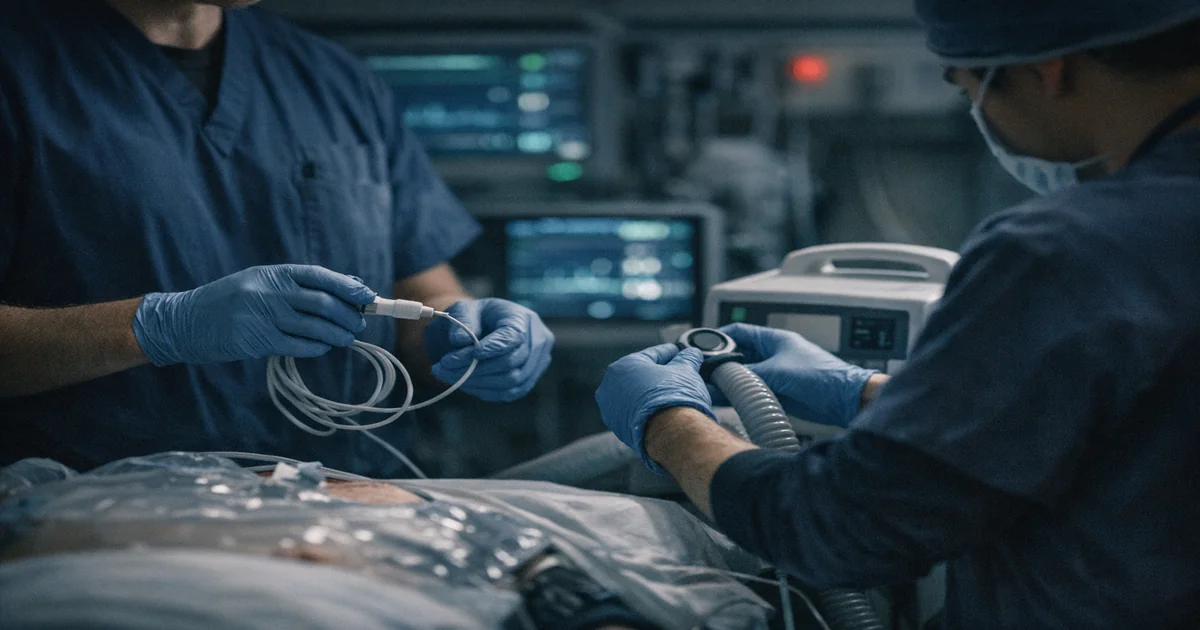
After ROSC, temperature management is a deliberate plan, not an automatic 33°C reflex. A practical ED guide to fever prevention, handoff, and current evidence.
A patient gets a pulse back. Then the work changes. The emergency team has to protect the brain, find the cause of the arrest, support the circulation, and move the patient to the next level of care without turning a single temperature number into a ritual.
The old shorthand was “start TTM at 33°C.” That is no longer a safe summary of the evidence. The current question is more useful: Is this adult following commands, what is the core temperature, and what deliberate plan will prevent fever while the team completes post-arrest care? The 2025 American Heart Association post-cardiac-arrest guideline updates temperature goals and duration alongside blood-pressure, oxygenation, ventilation, seizure, coronary, and neurologic-care recommendations.
The bedside decision starts with commands and core temperature
Temperature control is for the patient who remains unresponsive to verbal commands after return of spontaneous circulation, not for every patient who has briefly lost a pulse. The 2025 AHA guideline frames temperature control as a deliberate strategy, and its adult post-cardiac-arrest algorithm places that decision in the immediate post-ROSC pathway.
In the ED, make the assessment explicit. Is the patient awake and obeying commands? If not, place a reliable core-temperature probe and document the starting value. A peripheral skin reading can mislead the team when perfusion is poor. Continuous core-temperature monitoring is recommended for comatose adults after in-hospital or out-of-hospital arrest in the ERC-ESICM temperature-control guideline.
Do not let the word “hypothermia” force a treatment that the patient does not need. The 2023 AHA science advisory explains how the field moved from early trials of mild hypothermia toward a broader temperature-control strategy after later trials failed to show better outcomes from 33°C than from 36°C or strict normothermia. Fever still matters. The target is a controlled plan, not a reflexive number.
What the recent trials actually changed
The TTM2 trial randomized 1,900 adults who remained comatose after out-of-hospital cardiac arrest to targeted hypothermia at 33°C or targeted normothermia with early treatment of fever. Hypothermia did not improve survival or functional outcome, and arrhythmias with hemodynamic consequences were more common in the hypothermia group. That trial does not prove that every temperature target is equal in every patient. It does show why “cool everyone to 33°C” is not an evidence-safe default.
The duration question is separate. In Duration of Device-Based Fever Prevention after Cardiac Arrest, comatose survivors received 24 hours of temperature control at 36°C and then were assigned to shorter or longer device-based fever prevention. Extending device-based prevention to 72 total hours did not reduce death, severe disability, or coma compared with 36 total hours. The trial was not a license to stop watching temperature. It was a warning against assuming that a longer device protocol automatically improves neurologic recovery.
The 2022 European guideline recommended active fever prevention for at least 72 hours and found insufficient evidence to recommend for or against a 32–36°C target. The 2025 AHA guideline is now the current U.S. reference for the duration and target range. Read the actual protocol your receiving ICU uses, then communicate the ED’s start time, temperature, method, and complications during handoff. A transfer note that says “TTM started” is not enough.
The ED job: prevent secondary injury without creating new problems
First, stabilize the basics. Post-arrest care still requires attention to oxygenation, ventilation, blood pressure, glucose, cause of arrest, coronary evaluation, seizures, and disposition; the 2025 AHA guideline addresses each domain. Temperature management cannot substitute for treating ongoing shock, hypoxemia, recurrent dysrhythmia, or the cause of the arrest.
Second, prevent fever. The European guideline defines fever as a core temperature above 37.7°C and recommends active fever prevention for at least 72 hours in patients who remain comatose. If the patient arrives mildly hypothermic after ROSC, the same guideline recommends against actively rewarming solely to reach normothermia. It also advises against rapid infusion of large volumes of cold intravenous fluid for prehospital cooling.
Third, make the protocol visible. Assign one person to own the temperature plan during the transfer window. Record the probe site, the measured temperature, the intervention, the response, and the next reassessment. If shivering, hemodynamic instability, bleeding risk, or a rhythm problem changes the plan, say so directly. The 2025 AHA guideline treats temperature control as part of a larger post-arrest bundle, not as a stand-alone procedure.
Finally, do not use early exam findings to declare a neurologic outcome. Sedation, paralysis, temperature, metabolic abnormalities, seizures, and the arrest itself can all distort the bedside examination. The 2025 AHA guideline updates the timing and modalities of neuroprognostication. In the ED, the right handoff is “not yet assessable” when that is true.
Simulation turns the plan into a team behavior
Temperature control fails in practice when the team cannot answer basic questions: Who owns the probe? What is the target? What happens when the patient shivers? When will the ICU take over? Which parts of the plan must be repeated during transport? Those are workflow questions, not trivia questions.
A short post-ROSC simulation can rehearse the exact transition. One learner leads the medical plan. Another manages the temperature device and documents the trend. A third gives the receiving-unit handoff. The debrief should ask whether the team named the indication, chose a plan consistent with the current guideline, treated fever, and avoided turning a device into a substitute for clinical judgment. The EM-Sim catalog is a practical place to build deliberate practice around high-acuity decisions, while Global MedOps Command connects the simulation work to broader emergency-medicine operations. When the human factors are the limiting step, EMS-MedSim offers a natural companion for team-based simulation training.
Dr. Chet's Take
I have managed post-arrest patients in community emergency departments, tertiary resuscitation bays, and HEMS systems for more than 25 years. The old 33-degree reflex was easy to teach because it sounded decisive. That was its weakness. The current evidence gets the important point right: the patient needs a deliberate temperature plan, not a ritual that crowds out blood pressure, oxygenation, seizure recognition, coronary decisions, and a clean transfer.
That being said, I do not want this evidence translated into “temperature is no longer our problem.” Fever prevention is still a team responsibility. I have watched a patient arrive in an ICU with three different temperature stories: a skin thermometer in the ED, an esophageal probe during transport, and a device target that nobody could name. That is not a technology failure. It is a handoff failure. The honest answer is that we often remember the device and forget the plan.
If you are the attending, name the indication, the measured core temperature, the target strategy, and the next owner before the patient leaves your department. If you are in the bay, put those four facts in the verbal handoff and the record. The temperature plan is only as safe as the team that can repeat it.
Key Takeaways
- Use commands and a reliable core temperature to identify the adult who needs deliberate temperature control after ROSC; do not apply a reflexive 33°C script. 2025 AHA guideline
- Treat fever as a preventable secondary insult, and follow the receiving ICU’s current protocol for target and duration. ERC-ESICM guideline
- The TTM2 trial did not show better outcomes with 33°C than with targeted normothermia and early fever treatment. TTM2 trial
- A clean handoff names the probe, temperature, intervention, response, complications, and next owner.
- Early neurologic uncertainty is not a prognosis. Defer outcome claims to a guideline-based, multimodal assessment. 2025 AHA guideline
If you're a emergency physician, EM resident, medical student, or APP trying to understand how AI will actually impact your clinical practice — not just the hype — I put together a free practical guide. You can download it here: AI in EM Survival Guide.
FAQ
What temperature should an unresponsive adult reach after ROSC?
The current approach is a deliberate temperature-control strategy rather than an automatic 33°C target. The 2025 AHA guideline supplies the current U.S. recommendations; the receiving ICU’s protocol should guide the exact target, monitoring method, and duration.
Should every post-arrest patient receive targeted temperature management?
No. The key initial distinction is whether the adult remains unresponsive to verbal commands after ROSC. Patients who are awake and following commands do not fit the same temperature-control pathway. 2025 AHA post-arrest guidance
Does cooling to 33°C improve survival after cardiac arrest?
In TTM2, targeted hypothermia at 33°C did not improve survival or functional outcome compared with targeted normothermia and early fever treatment in comatose adults after out-of-hospital cardiac arrest. TTM2 trial
How long should fever prevention continue after ROSC?
The answer depends on the guideline and local protocol. The 2022 European guideline recommended active fever prevention for at least 72 hours, while later trial data found no significant benefit from extending device-based prevention from 36 to 72 total hours. ERC-ESICM guideline Duration trial
When should the ED prognosticate neurologic outcome?
Do not use an early, confounded examination as a final outcome statement. Follow the 2025 AHA guideline’s timing and multimodal approach, and communicate uncertainty clearly during transfer. 2025 AHA guideline
Sources
- American Heart Association. Part 11: Post-Cardiac Arrest Care: 2025 American Heart Association Guidelines
- American Heart Association. Adult Post–Cardiac Arrest Care Algorithm
- AHA. Temperature Management for Comatose Adult Survivors of Cardiac Arrest
- ERC and ESICM. Guidelines on temperature control after cardiac arrest in adults
- Dankiewicz J, et al. Hypothermia versus Normothermia after Out-of-Hospital Cardiac Arrest
- Kirkegaard H, et al. Duration of Device-Based Fever Prevention after Cardiac Arrest
- Books by Dr. Shermer