Convulsive Status Epilepticus in the ED: Dose, Then Decide
Chester "Chet" Shermer, MD, FACEP · September 3, 2026
About the author: Dr. Chester Shermer, MD, FACEP
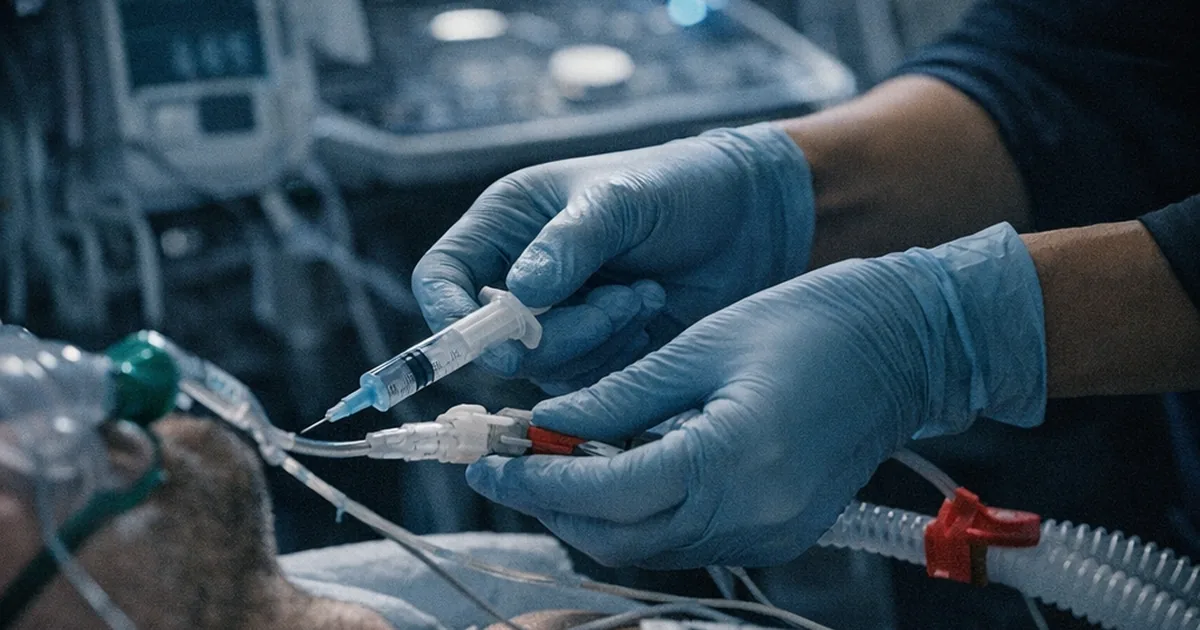
A practical ED sequence for adult convulsive status epilepticus: treat at five minutes, dose the benzodiazepine fully, choose a second-line agent, and keep airway and EEG decisions active.
The patient is still convulsing when the stretcher reaches the resuscitation bay. Someone says, “We gave a little midazolam.” No one can say how much. The IV is not in. The clock is already moving.
Convulsive status epilepticus is a time problem before it is a drug-selection problem. Treat at five minutes, give a full benzodiazepine dose by a route you can deliver now, and move to a second-line antiseizure medication when the first step fails. The 2024 American College of Emergency Physicians (ACEP) policy gives adult ED clinicians a clear second-line position: levetiracetam, fosphenytoin, or valproate are reasonable choices with similar efficacy. (ACEP 2024 clinical policy)
The first decision is the clock
A generalized convulsive seizure that lasts more than five minutes should be treated as status epilepticus because spontaneous termination becomes less likely and ongoing convulsions can cause respiratory compromise. (Kapur, “Strategies to innovate emergency care of status epilepticus,” 2024) Do not wait for a perfect diagnosis while the patient continues to seize. At the same time, the ACEP policy is narrower than a universal seizure protocol: it addresses adults with generalized convulsive seizures in the ED and excludes children, pregnancy, trauma, brain mass, immunocompromise, eclampsia, and out-of-hospital care. (ACEP 2024 clinical policy)
Assess airway and breathing, check glucose, obtain access, and monitor the patient while giving the benzodiazepine. Prolonged convulsions themselves create respiratory risk, and fear of respiratory depression should not lead to underdosing. (Kapur, 2024)
Give the benzodiazepine you can deliver now
A route that arrives late is not safer than a route that arrives now. In RAMPART, a randomized trial of children and adults treated by paramedics, IM midazolam stopped seizures without rescue medication at ED arrival in 73.4% of patients, compared with 63.4% after IV lorazepam. The groups had similar rates of acute intubation: 14.1% with midazolam and 14.4% with lorazepam. (Silbergleit et al., “Intramuscular versus intravenous therapy for prehospital status epilepticus,” 2012)
That result does not turn one route into a universal rule. It does support a simple operational choice: if IV access is delaying treatment, IM midazolam is an evidence-based route for appropriate patients. The 2024 ACEP policy uses diazepam 10 mg, lorazepam 4 mg, midazolam 10 mg, or a weight-based equivalent as the threshold for an appropriately dosed first-line treatment in the evidence it reviewed. (ACEP 2024 clinical policy) Follow your local medication concentration, route, and repeat-dose protocol.
In an ESETT dosing analysis, only 32.4% of first benzodiazepine doses met minimum guideline recommendations; adult first doses met the recommendation in 17% of cases. The dataset could not confirm that every dose was for status epilepticus, but it exposes a familiar failure: giving a cautious fraction and waiting for a response that never comes. (Sathe et al., “Patterns of benzodiazepine underdosing in the Established Status Epilepticus Treatment Trial,” 2021)
After an appropriate benzodiazepine, prepare the second-line drug while reassessing ventilation, hemodynamics, glucose, temperature, and whether the movements remain epileptic.
Pick a second-line drug without pretending one is best
The ESETT randomized trial compared IV levetiracetam, fosphenytoin, and valproate in patients with convulsive status epilepticus that did not respond to benzodiazepines. At 60 minutes, seizure cessation with improved alertness occurred in 47% of patients assigned to levetiracetam, 45% assigned to fosphenytoin, and 46% assigned to valproate. The trial found similar adverse-event rates and stopped for futility of identifying a superior agent. (Kapur et al., “Randomized Trial of Three Anticonvulsant Medications for Status Epilepticus,” 2019)
The ACEP 2024 policy therefore gives a Level A recommendation to treat benzodiazepine-refractory seizures with a second-line agent, while allowing any of the three ESETT drugs. The listed doses are levetiracetam 60 mg/kg IV, maximum 4,500 mg; fosphenytoin 20 mg phenytoin equivalents/kg IV, maximum 1,500 mg PE; or valproate 40 mg/kg IV, maximum 3,000 mg. The policy lists AV block and sinus bradycardia as fosphenytoin contraindications and hepatic disease as a valproate contraindication. (ACEP 2024 clinical policy)
Choose by patient factors and logistics. Conduction disease makes fosphenytoin less attractive; liver disease makes valproate less attractive. Medication history, allergy, access, and local stock may decide the rest. The evidence does not identify one universal winner. (ACEP 2024 clinical policy; ESETT trial)
These drugs work in about half of benzodiazepine-refractory patients. Continued seizure after a correctly dosed second-line medication needs an escalation plan, not a debate over which drug should have been chosen. (Kapur, 2024)
Airway decisions belong beside seizure treatment
Plan the airway from the first dose, but do not intubate automatically because of the seizure label. Assess oxygenation, ventilation, protective reflexes, trajectory, secretions, trauma, and the need for anesthetic therapy. ESETT counted intubation as treatment failure, so its 45–47% efficacy numbers do not promise airway avoidance. (Kapur, 2024)
When movements stop but the patient does not wake, do not assume the seizure problem is over. A 2024 review describes rapid EEG as feasible when visible convulsions have ended but consciousness remains impaired. Consider medication effect, hypoglycemia, hypoxia, hyperthermia, toxic exposure, structural disease, and ongoing electrographic seizure activity. (Kapur, 2024)
Failure after a second-line drug is refractory status epilepticus. These patients often need anesthetic infusion, airway control, critical-care consultation, and ICU transfer under local protocols. Keep searching for correctable causes such as hypoglycemia, sodium abnormality, toxic ingestion, infection, stroke, or hemorrhage. (Kapur, 2024)
Turn the protocol into a team behavior
Make the next action visible: put onset time on the board, name the benzodiazepine giver, record dose and route, and set a five-minute reassessment. If seizure continues, announce the second-line choice while another clinician stays on the airway.
Rehearse this in the EM-Sim scenario catalog: unclear dose history, delayed access, an underdosed first medication, and a second-line choice while managing ventilation. The same route-and-dose practice appears at EMS-MedSim. The larger Global MedOps Command work follows the same rule: high-stakes decisions improve when teams rehearse the clock and the next owner.
Dr. Chet's Take
I have spent more than 25 years in emergency medicine, including HEMS and Guard medical leadership, and status epilepticus punishes hesitation. The clinical position is simple. Treat the seizure at five minutes. Give the full benzodiazepine dose by the route you can deliver. Move to a second-line drug when the first step fails. That sequence protects the patient from the quiet delay that looks cautious but is not.
That being said, the bedside is not a trial protocol. I have seen a team argue over levetiracetam versus fosphenytoin while no one could state the last dose or the seizure-onset time. That is not pharmacology. That is a systems failure. The ESETT result is useful because it removes a false contest between three reasonable second-line choices. It does not remove the need to watch the airway, correct the cause, or call critical care when the patient keeps seizing.
If you are the attending, put the clock and the medication times where the whole room can see them. If you are in the bay, say the dose, route, and reassessment time out loud. Then give the next clinician a plan they can act on. A seizure protocol is only real when the team can run it under pressure.
Key Takeaways
- Treat generalized convulsive seizure activity at five minutes. (Kapur, 2024)
- Give a full benzodiazepine dose by the route that reaches the patient first. (RAMPART trial; ACEP 2024 clinical policy)
- After failure, choose levetiracetam, fosphenytoin, or valproate by patient factors and local protocol. (ESETT trial)
- Keep airway, cause-finding, and escalation planning active. (Kapur, 2024)
FAQ
What is the best first-line benzodiazepine for adult status epilepticus?
Use the appropriately dosed benzodiazepine that you can deliver without delay. RAMPART found IM midazolam noninferior and statistically superior to IV lorazepam for seizure cessation before ED arrival in the prehospital setting, with similar acute intubation rates; the 2024 ACEP policy identifies diazepam 10 mg, lorazepam 4 mg, midazolam 10 mg, or a weight-based equivalent as appropriate treatment in its evidence framework. (RAMPART trial; ACEP 2024 clinical policy)
Which second-line medication should I use after benzodiazepines fail?
For the adult generalized convulsive ED population addressed by ACEP, levetiracetam, fosphenytoin, or valproate may be used with similar efficacy. Use contraindications, comorbidities, medication history, access, infusion logistics, and local protocol to choose. (ACEP 2024 clinical policy; ESETT trial)
What if the patient is still unconscious after the convulsions stop?
Do not equate visible seizure cessation with neurologic recovery. Check glucose, oxygenation, ventilation, medication effect, toxic and structural causes, and electrographic seizure activity; rapid EEG may help. (Kapur, 2024)
Sources
- ACEP adult seizure clinical policy, 2024
- ACEP policy PubMed record
- RAMPART trial
- ESETT trial
- ESETT benzodiazepine underdosing analysis
- 2024 status epilepticus review
- Related simulation training: EMS-MedSim
- Related operations guidance: Global MedOps Command (main site)
- Books by Dr. Shermer
If you're an emergency physician, EM resident, medical student, or APP trying to understand how AI will actually impact your clinical practice — not just the hype — I put together a free practical guide. You can download it here: AI in EM Survival Guide.