Spontaneous Pneumothorax in the ED: Observe, Vent, or Drain
Chester "Chet" Shermer, MD, FACEP · November 5, 2026
About the author: Dr. Chester Shermer, MD, FACEP
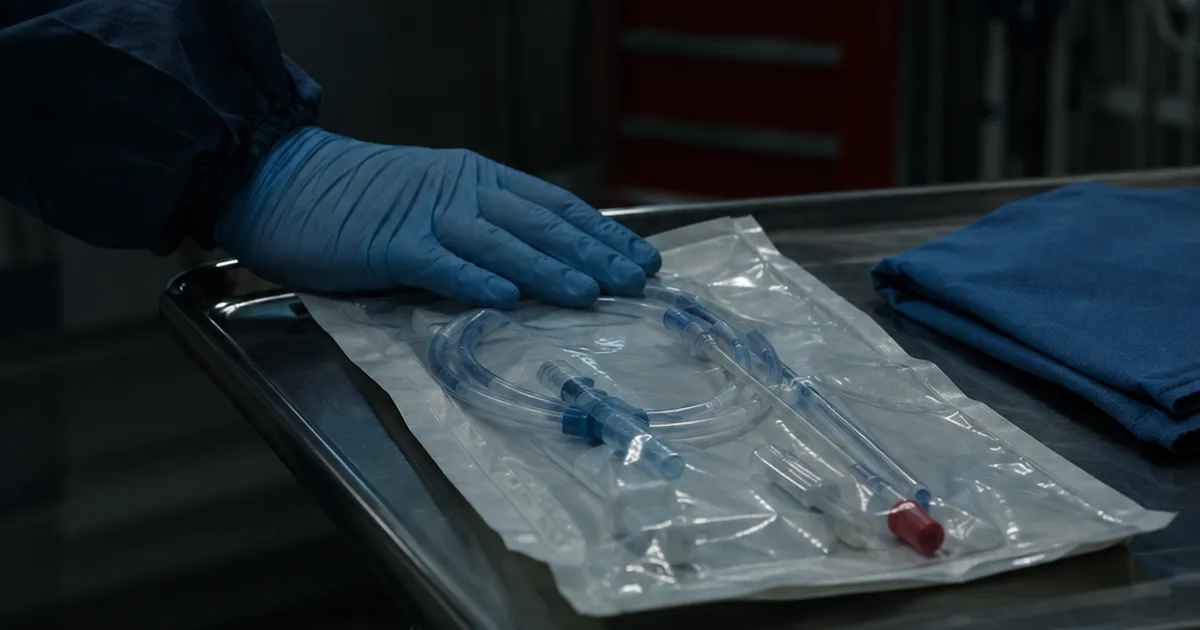
The PSP and RAMPP trials and the 2023 BTS guideline moved primary spontaneous pneumothorax away from the reflex chest tube. Criteria, trade-offs, and who stays out.
The 22-year-old warehouse worker has had left-sided chest pain since he lifted a pallet yesterday afternoon. He is talking in full sentences, his SpO2 is 97% on room air, and his heart rate is 88. The portable film shows a left pneumothorax with a visible pleural line from apex to base. The resident already has the chest tube tray open on the Mayo stand.
Bottom line: a stable, minimally symptomatic first primary spontaneous pneumothorax can be observed and sent home regardless of size; a symptomatic one should be offered an ambulatory valve or aspiration before a tube and an admission.
What the PSP Trial Tested
The Primary Spontaneous Pneumothorax (PSP) trial was a multicenter, open-label, randomized noninferiority trial at 39 metropolitan and rural hospitals in Australia and New Zealand, enrolling from July 2011 to March 2017 [1]. Patients were 14 to 50 years old with a first-known unilateral primary spontaneous pneumothorax of 32% or more by the Collins method on chest radiograph [1]. The trial randomized 316 patients: 154 to intervention and 162 to conservative care [1].
The interventional arm received a small-bore (12 French or smaller) Seldinger drain to underwater seal without suction, a repeat film at 1 hour, a clamp trial with a stopcock, and removal and discharge 4 hours later if the lung stayed up [1]. The conservative arm was observed for at least 4 hours with a repeat film, then discharged with analgesia if the patient needed no oxygen and was walking comfortably [1]. Crossover to intervention was allowed for symptoms uncontrolled by analgesia, pain or dyspnea preventing mobilization, patient preference, or physiologic instability, defined as systolic pressure below 90 mm Hg, heart rate at or above systolic pressure, respiratory rate above 30, or SpO2 below 90% on room air [1]. Only 25 of 162 conservative patients (15.4%) ended up with an intervention [1].
The primary outcome was full lung reexpansion within 8 weeks, with a noninferiority margin of minus 9 percentage points. In the complete-case analysis, 98.5% of the intervention group and 94.4% of the conservative group reexpanded (risk difference minus 4.1 points, 95% CI minus 8.6 to 0.5, P = 0.02 for noninferiority) [1].
The secondary outcomes favored observation. Recurrence at 12 months was 16.8% after intervention and 8.8% after conservative care (risk difference 8.0 points, 95% CI 0.5 to 15.4) [1]. Median hospital stay over 8 weeks was 3.8 days versus 0.2 days [1]. Adverse events occurred in 26.6% versus 8.0% (RR 3.32, 95% CI 1.85 to 5.95), and serious adverse events in 12.3% versus 3.7% (RR 3.30, 95% CI 1.37 to 8.10) [1]. The intervention group had 34 VATS procedures in 33 patients and 6 thoracotomies; the conservative group had 10 VATS procedures [1]. Prespecified subgroups by age, clinician-estimated size, symptom duration, and smoking status showed no treatment-effect interaction [1].
The Missing-Data Problem
The PSP result has one weakness worth knowing before you quote it at the bedside. Eight-week data were missing for 23 intervention patients and 37 conservative patients [1]. Extending the window to 63 days preserved noninferiority (minus 3.7 points, 95% CI minus 7.9 to 0.6) [1]. Counting every missing patient as a treatment failure did not: 93.5% versus 82.5%, a difference of minus 11.0 points (95% CI minus 18.4 to minus 3.5), outside the margin [1]. The authors concluded that conservative management was noninferior while stating plainly that the primary outcome did not hold under conservative assumptions about missing data [1].
Symptom outcomes were nearly identical. Complete symptom resolution by 8 weeks was 93.4% with intervention and 94.6% with observation, with median time to symptom resolution of 15.5 and 14.0 days [1]. Radiographic resolution took longer without a drain, at a median of 30 days versus 16 days (HR 0.49, 95% CI 0.39 to 0.63) [1]. Patients managed conservatively lose time to a resolving film. They gain fewer procedures, fewer complications, and fewer recurrences.
Ambulatory Valves in RAMPP
The Randomised Ambulatory Management of Primary Pneumothorax (RAMPP) trial addressed the patient who does need something. It was an open-label randomized trial at 24 UK hospitals from August 2015 to March 2019 [2]. Adults 16 to 55 with symptomatic primary spontaneous pneumothorax requiring intervention under BTS criteria were eligible, meaning an interpleural distance of 2 cm or more at the hilum, significant symptoms, or both [2]. Exclusions included known lung disease or more than 20 pack-years of smoking, tension physiology needing urgent decompression, pregnancy, and lactation [2].
The ambulatory arm (n = 117) received an 8 French catheter with an integrated one-way valve and went home after 1 to 2 hours if stable, with review every 1 to 2 days until day 4 [2]. Standard care (n = 119) followed BTS practice: aspiration of up to 2.5 L through a 14 to 16 gauge cannula, then a drain of 14 French or smaller with admission if the lung did not reexpand [2]. Aspiration was the first step in 68% of standard-care patients, and 47% of those went on to a drain [2].
Median total hospital stay over 30 days was 0 days (IQR 0 to 3) with ambulatory care and 4 days (IQR 0 to 8) with standard care, a median difference of 2 days (95% CI 1 to 3) [2]. Same-day discharge was 64% versus 34% [2]. Further pleural procedures were needed in 21% versus 35% [2]. The safety cost was real: all 14 serious adverse events occurred in the ambulatory arm (12% versus 0%), each because it led to readmission, including 4 enlarging pneumothoraces and 2 blocked or kinked devices [2]. Three unrecognized hemopneumothoraces in that arm all had significant fluid on the pre-procedure film [2]. Length-of-stay benefit held inside each subgroup: median difference 2 days in women and men, 1 day with and 2 days without prior pneumothorax, and 2 days in ever and never tobacco smokers [2].
What BTS 2023 Changed
The 2023 British Thoracic Society pleural guideline built its pathway on these two trials. Conservative management can be considered for minimally symptomatic or asymptomatic primary spontaneous pneumothorax "regardless of size," with minimally symptomatic defined as no significant pain or breathlessness and no physiological compromise [3]. Ambulatory management should be considered for patients with good support in centers with expertise and follow-up [3]. Aspiration or tube drainage is the option for patients unsuited to either [3]. All three are conditional recommendations, and the first is graded by consensus [3].
The guideline states that size is no longer an indication for invasive management, though it still governs whether an intervention is safe to perform [3]. Patients managed by observation or aspiration return for a film at 2 to 4 weeks, and commercial flight waits until 7 days after a film shows full resolution [3].
Who Stays Out of the Observation Pathway
The trial populations define the boundaries. BTS classifies patients older than 50 with a smoking history as secondary pneumothorax regardless of known lung disease [3]. PSP enrolled only first episodes in patients 50 or younger, and RAMPP excluded known lung disease and heavy smokers [1,2]. BTS lists tension at first presentation, synchronous bilateral pneumothorax, and spontaneous hemothorax among presentations that warrant surgical advice [3]. The PSP instability criteria (systolic pressure below 90, heart rate at or above systolic pressure, respiratory rate above 30, SpO2 below 90%) mark the patients who needed a procedure in that trial [1].
Key Takeaways
- Stable first primary spontaneous pneumothorax with no significant pain, no dyspnea, and no physiological compromise: observe at least 4 hours, repeat the film, and discharge regardless of size, with a 2 to 4 week follow-up film [1,3].
- In the PSP trial, observation cut 12-month recurrence from 16.8% to 8.8% and serious adverse events from 12.3% to 3.7%, with only 15.4% crossing over to a procedure [1].
- Noninferiority failed when missing 8-week data were counted as failures (minus 11.0 points), so tell patients to expect a slower film, median 30 days to resolution [1].
- For symptomatic patients, an 8 French ambulatory valve cut median 30-day hospital stay from 4 days to 0 but carried a 12% readmission-driven serious adverse event rate; check the film for fluid first [2].
FAQ
Does a large spontaneous pneumothorax need a chest tube?
Not automatically. In the PSP trial, patients with first pneumothoraces of 32% or more managed without a drain had noninferior lung reexpansion in the complete-case analysis, half the recurrence rate, and fewer serious adverse events [1]. BTS 2023 states that size alone is no longer an indication for invasive management [3].
How long should you observe a pneumothorax before discharge?
The PSP trial observed patients for at least 4 hours and repeated the chest film before discharge [1]. Discharge required no supplemental oxygen and comfortable walking [1]. Patients managed this way return for a follow-up film at 2 to 4 weeks [3].
Can patients fly after a spontaneous pneumothorax?
BTS 2023 advises against commercial flights until a chest film shows complete resolution, and then a wait of 7 days after that film [3]. Patients managed conservatively in the PSP trial had a median of 30 days to radiographic resolution, so plan for a month or more grounded [1]. Scuba diving is discouraged permanently unless a definitive surgical prevention procedure has been done [3].
Dr. Chet's Take
I have spent more than 25 years as an emergency physician at a Level I academic trauma center, and the chest tube for a stable young pneumothorax is one of the most durable reflexes in our specialty. This article gets the argument right. The evidence now says that the procedure we were trained to do first is often the one that creates the complication, the admission, and the trip to the operating room. The core argument holds because the outcomes that matter to the patient all point the same way. The one that does not, the slower film, is a cosmetic delay for someone who is walking around and back at work. What changes on the shift is the conversation. Observation only works when the patient understands the plan, trusts it, and comes back.
That being said, the trial is less clean than the headline, and I would not oversell it to a skeptical colleague. Missing follow-up is the honest weakness, and it is the same problem we will face with our own patients. The young man who feels fine on day three is the least likely person in the ED to keep a radiology appointment. The honest answer is that observation is only as safe as your return-precaution system. I also think we underuse the decision aid we already have: asking the patient what matters to him. Some will choose the faster film and accept a tube. Others will choose to avoid a procedure. Both are defensible when the patient is stable and informed.
If you are the attending, write the follow-up film order and the return precautions before the patient leaves, and make sure someone owns the call if he misses it. A missed film with no callback turns an evidence-based plan into an unmonitored one. If you are the resident with the tray open, stop and reassess the patient before you reach for the drain. Check his vital signs against the instability criteria, ask about prior episodes and smoking history, and read the whole film down to the costophrenic angles. Then have the conversation about options at the bedside, with the patient sitting up and listening. Document the options you offered and the one he chose. Placing a drain in that patient is now the choice that needs a documented reason.
— Chester Shermer, MD, FACEP | Emergency Medicine, 25+ Years Clinical Experience | State Surgeon
Continue Your Training
If you're an emergency physician (or any clinician treating patients daily) trying to understand how AI will actually impact your clinical practice — not just the hype — I put together a free practical guide. You can download the AI in EM Survival Guide here.
Browse All Courses at Global MedOps Command
Relevant Reading on Global MedOps Command:
How to Avoid Becoming an AI Casualty — Dr. Shermer's guide to navigating AI tools in clinical and operational settings without compromising judgment or patient outcomes.
Emergency Department Efficiency Playbook — Practical systems for throughput, triage optimization, and operational efficiency.
Read more from Dr. Shermer on Medium
Connect with Dr. Shermer: LinkedIn — Chester "Chet" Shermer, MD, FACEP.
References
- Brown SGA, Ball EL, Perrin K, et al. Conservative versus interventional treatment for spontaneous pneumothorax. N Engl J Med. 2020;382(5):405-415. PubMed 31995686
- Hallifax RJ, McKeown E, Sivakumar P, et al. Ambulatory management of primary spontaneous pneumothorax: an open-label, randomised controlled trial. Lancet. 2020;396(10243):39-49. PubMed 32622394
- Roberts ME, Rahman NM, Maskell NA, et al. British Thoracic Society guideline for pleural disease. Thorax. 2023;78(Suppl 3):s1-s42. PubMed 37433578
Related simulation training: EMS-MedSim · Books by Dr. Shermer