Recent-Onset AF in the ED: Wait, Procainamide, or Shock
Chester "Chet" Shermer, MD, FACEP · October 29, 2026
About the author: Dr. Chester Shermer, MD, FACEP
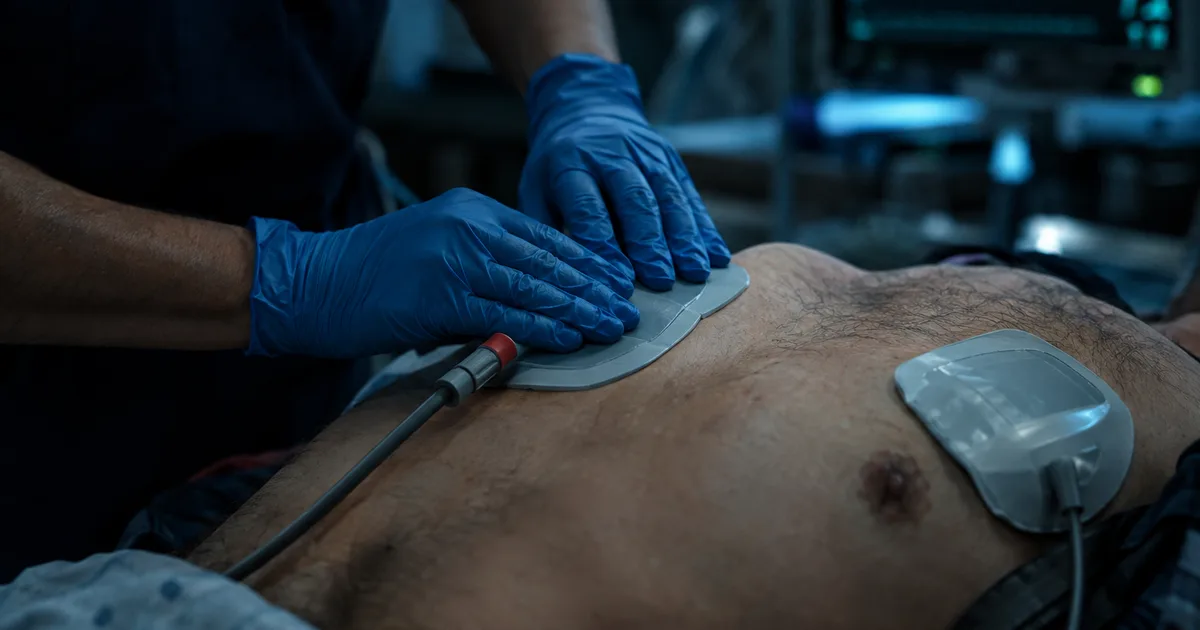
RACE 7 ACWAS, RAFF2, and RAFF4 compared wait-and-see rate control, procainamide, and electrical cardioversion for stable recent-onset AF. Here are the numbers and the criteria.
A patient arrives with palpitations that started at dinner, a heart rate of 140, and an irregularly irregular rhythm on the monitor. Blood pressure is fine, the troponin is normal, and the patient wants to know whether they are going home tonight. The choice in front of you is no longer simply shock versus no shock. Two Canadian trials and one Dutch trial now tell you what happens with each strategy, and the answers are closer together than most departments practice.
Bottom line: in a stable patient with a clear onset under 36 to 48 hours, rate control with a planned recheck and same-visit cardioversion both end in sinus rhythm for more than 90% of patients. Pick by onset clarity, stroke risk, and what the patient wants, then anticoagulate by CHA2DS2-VASc rather than by rhythm.
Wait and See Holds Up
RACE 7 ACWAS was a multicenter, open-label, noninferiority trial at 15 hospitals in the Netherlands, enrolling from October 2014 through September 2018 [1]. Adults with hemodynamically stable, symptomatic, recent-onset atrial fibrillation (AF) of under 36 hours were eligible; signs of myocardial ischemia and a history of persistent AF (over 48 hours) were exclusions [1]. The delayed group got rate control only, titrated to a heart rate of 110 or less, mostly with beta-blockers (155 patients), with cardioversion the next day if AF persisted at 48 hours [1]. Five patients got a nondihydropyridine calcium-channel blocker, 13 got digoxin, and 19% reached the rate target without any added rate-control drug [1]. The early group got cardioversion during the index visit, preferably with flecainide [1].
The primary outcome was sinus rhythm at 4 weeks: 91% delayed (193 of 212) versus 94% early (202 of 215), a difference of −2.9 percentage points (95% CI −8.2 to 2.2), meeting the −10 point noninferiority margin [1]. In the delayed group, 69% converted spontaneously within 48 hours and 28% needed delayed cardioversion [1]. In the early group, 16% converted on their own before anyone intervened [1].
Recurrence on 4-week remote monitoring was 30% versus 29% (HR 0.97, 0.65 to 1.43) [1]. The median index visit was 120 minutes for wait-and-see and 158 minutes for early cardioversion [1]. Cardiovascular complications occurred in 10 versus 8 patients, including 1 ischemic stroke in the delayed group and 1 transient ischemic attack in the early group, with no deaths [1]. Return ED visits for recurrent AF were 7% in each group, and only 3 delayed and 5 early patients were admitted [1].
Drug First or Shock First
RAFF2 enrolled 396 patients at 11 Canadian academic emergency departments from 2013 to 2018 [2]. Patients needed at least 3 hours of AF with a clear onset within 48 hours, or within 7 days if anticoagulated for more than 4 weeks or cleared by transesophageal echocardiography [3]. Systolic pressure under 100, preexcitation, acute coronary syndrome, pulmonary edema, LVEF under 30%, QTc over 460 ms, and heart rate under 55 were exclusions [3].
The drug-shock arm got intravenous procainamide 15 mg/kg over 30 minutes, then up to three shocks of at least 200 J if needed; the shock-only arm got a blinded placebo infusion and then the same shocks [2]. Conversion to sinus rhythm for at least 30 minutes occurred in 96% with drug-shock and 92% with shock-only (absolute difference 4%, 95% CI 0 to 9, p=0.07) [2]. Procainamide alone converted 52% and spared them procedural sedation [2]. Discharge home was 97% versus 95%, and no patient had a serious adverse event in follow-up [2].
The nested pad trial found no meaningful difference: 94% conversion with anterolateral pads and 92% with anteroposterior pads (p=0.68) [2].
A Faster Drug, If You Have It
RAFF4 compared vernakalant with procainamide in 350 patients at 12 Canadian emergency departments from 2021 to 2024 [4]. Vernakalant (3 mg/kg over 10 minutes, then 2 mg/kg if needed) converted 62.4% versus 48.3% for procainamide given over 60 minutes (adjusted difference 15.0%, 95% CI 4.6 to 25.0) [4]. Successful conversion came at 21.8 versus 44.7 minutes [4]. Adverse events were 17.4% versus 25.0%, and hypotension forced a stop to the procainamide infusion in 8.7% [4]. Vernakalant is not available in the United States, so the practical lesson for US departments is the procainamide hypotension rate and the 60-minute infusion time [4].
Anticoagulation Decides Who Goes Where
Rhythm strategy and stroke prevention are separate decisions. The 2023 ACC/AHA/ACCP/HRS guideline notes that thromboembolic risk after cardioversion in AF under 48 hours is not uniform and rises with CHA2DS2-VASc, especially at a score of 2 or more without anticoagulation [5]. It cites the FinCV data showing 30-day thromboembolism of 0.4% with a score of 0 to 1 and 0.3% when AF lasted under 12 hours, and it identifies that combination as a particularly low-risk group [5]. The guideline also describes anticoagulation for the 4 weeks after cardioversion, driven by atrial stunning and early recurrence [5].
RACE 7 handled this explicitly: high-risk patients not already anticoagulated started anticoagulation before or immediately after cardioversion, and 29% began it at the index visit [1]. Both cerebral embolic events in that trial occurred in patients who had started a direct oral anticoagulant at the index visit, at 5 and 10 days, with CHA2DS2-VASc scores of 2 and 3 [1].
Choosing at the Bedside
Use the trials' eligibility criteria as your guardrails. A patient outside them, with a fuzzy onset, sepsis or pneumonia driving the rate, ischemia, preexcitation, or hypotension, is a different problem from the one these trials answered.
Before procainamide, check the QTc and heart rate against the RAFF2 exclusions of 460 ms and 55 beats per minute [3]. For an eligible patient who wants rhythm control tonight, start with procainamide if the pressure tolerates it, then shock if it fails, or go straight to sedation and synchronized cardioversion. For a patient with a reliable onset who prefers to avoid sedation, rate control with a structured recheck at 48 hours gives the same 4-week result. That path needs a follow-up system that actually exists, since nearly a third of the delayed group still needed cardioversion [1].
Key Takeaways
- Wait-and-see rate control to 110 or less reached 91% sinus rhythm at 4 weeks versus 94% with early cardioversion [1].
- Procainamide 15 mg/kg converted 52% on its own, and drug-shock reached 96% versus 92% for shock-only [2].
- Pad position did not matter: 94% anterolateral versus 92% anteroposterior [2].
- Anticoagulate by CHA2DS2-VASc; postcardioversion stroke risk climbs at a score of 2 or more without it [5].
FAQ
Is it safe to discharge recent-onset AF on rate control alone?
In RACE 7 ACWAS, stable patients with AF under 36 hours discharged on rate control had 69% spontaneous conversion within 48 hours and 91% sinus rhythm at 4 weeks [1]. The trial required a next-day revisit for cardioversion if AF persisted.
How effective is procainamide for atrial fibrillation in the ED?
In RAFF2, intravenous procainamide 15 mg/kg over 30 minutes converted 52% of patients without a shock [2]. In RAFF4, given over 60 minutes, it converted 48.3%, and hypotension stopped the infusion in 8.7% [4].
Does pad placement matter for cardioverting atrial fibrillation?
RAFF2 found 94% conversion with anterolateral pads and 92% with anteroposterior pads, which was not a significant difference [2]. Use whichever position you can place quickly and correctly.
Dr. Chet's Take
I have worked as an emergency physician for more than 25 years, and AF with a fast rate is one of the conditions where department habit drives practice more than evidence. Some groups shock nearly everyone. Others admit nearly everyone. Neither habit came from a trial. This article gets the central point right: the two strategies land in nearly the same place at a month, which means the choice belongs to the patient and the system, and you cannot make it by reflex. What I would add is that the hardest part of the visit is usually the history. Pinning down when the palpitations really started takes deliberate questioning. Patients round off, and families fill in gaps with guesses. If the onset is not clear, the eligibility for any of these strategies is not clear either.
That being said, wait-and-see is only as good as the follow-up it depends on. In a community or rural setting, a next-day rhythm check is a real appointment that somebody has to own, with a phone call, an ECG, and a plan if the rate is still high. I would not send a patient out on rate control without knowing who sees them and when. I also want the anticoagulation decision made before the patient leaves the department, in plain language, with the prescription in hand. Patients who walk out in sinus rhythm tend to assume the problem is solved. Their stroke risk over the next month is the same either way, and the discharge conversation has to say so.
If you are the emergency physician deciding tonight, pin down onset to the hour, score CHA2DS2-VASc out loud, and give the patient the real choice with the real numbers. If you run the department, build the 48-hour recheck pathway with cardiology before you need it, and write procainamide and sedation-cardioversion order sets so the shift does not improvise. Agree with your cardiologists in advance on which patients they want to see the next morning and which can follow up in the clinic within a week. If you teach residents, make them present the onset time and the stroke score before they present the plan, on every AF patient they staff. Their answer about which strategy the patient chose shows you whether the patient was offered a real choice.
— Chester Shermer, MD, FACEP | Emergency Medicine, 25+ Years Clinical Experience | State Surgeon
Continue Your Training
If you're an emergency physician (or any clinician treating patients daily) trying to understand how AI will actually impact your clinical practice — not just the hype — I put together a free practical guide. You can download the AI in EM Survival Guide here.
Browse All Courses at Global MedOps Command
Relevant Reading on Global MedOps Command:
How to Avoid Becoming an AI Casualty — Dr. Shermer's guide to navigating AI tools in clinical and operational settings without compromising judgment or patient outcomes.
Emergency Department Efficiency Playbook — Practical systems for throughput, triage optimization, and operational efficiency.
Read more from Dr. Shermer on Medium
Connect with Dr. Shermer: LinkedIn — Chester "Chet" Shermer, MD, FACEP.
References
- Pluymaekers NAHA, Dudink EAMP, Luermans JGLM, et al. Early or delayed cardioversion in recent-onset atrial fibrillation. N Engl J Med. 2019;380(16):1499-1508. PubMed 30883054
- Stiell IG, Sivilotti MLA, Taljaard M, et al. Electrical versus pharmacological cardioversion for emergency department patients with acute atrial fibrillation (RAFF2): a partial factorial randomised trial. Lancet. 2020;395(10221):339-349. PubMed 32007169
- Stiell IG, et al. Trial of electrical versus pharmacological cardioversion for RAFF in the ED (RAFF2). ClinicalTrials.gov NCT01891058. ClinicalTrials.gov NCT01891058
- Stiell IG, Taljaard M, Eagles D, et al. Vernakalant versus procainamide for rapid cardioversion of patients with acute atrial fibrillation (RAFF4): randomised clinical trial. BMJ. 2025;391:e085632. PubMed 41218981
- Joglar JA, Chung MK, Armbruster AL, et al. 2023 ACC/AHA/ACCP/HRS guideline for the diagnosis and management of atrial fibrillation. Circulation. 2024;149(1):e1-e156. PubMed 38033089
Related simulation training: EMS-MedSim · Books by Dr. Shermer